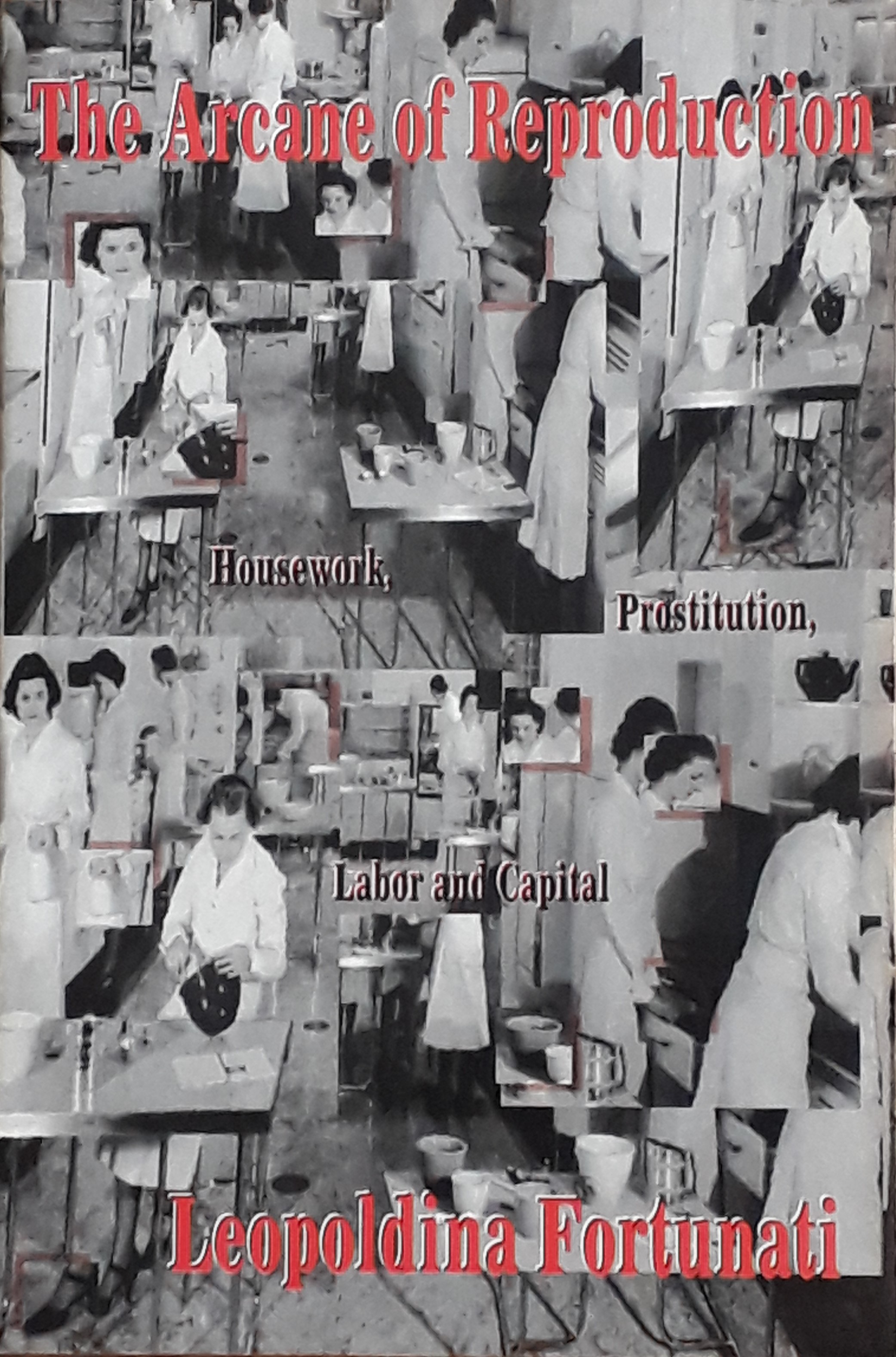
published in 1981, in English in 1995 by Autonomedia
notes written in 2017 for a grad school comprehensive paper on autonomy
Fortunati adds a gendered analysis of reproduction to the Marxist understanding of capitalism. She re-formulates the concepts of production, use and exchange value, and variable capital/labor-power, observing them from the perspective of reproduction, and she elaborates a theory of reproduction that is totally absent in Marx. This core of her theory of reproduction is that it’s the sine qua non of all capitalism since there is no capitalism without labor-power, yet capital ‘naturalizes’ reproduction and is therefore able to benefit from labor-power without paying for it. Women ‘freely’ exchange their unwaged, un-valued reproductive labor for a share in male wages, thereby passing along to the capitalist a second non-equivalent exchange, alongside the commodities-for-wages exchange, and further increasing surplus value accumulation. This comparison of productive and reproductive labor allows Fortunati to deepen a number of Marxist concepts, including our very understandings of class and class struggle. Most importantly, we learn that capital must internally divide labor if it’s to successfully undervalue reproduction.
We can better understand reproduction by comparing it with production. 1) While production is cast as the production and the only source of value, reproduction is ‘natural’ and said to produce no value. So production’s value creation is waged and exploitation happens via the unequal exchange of wages for commodities, while reproduction’s production of labor-power is unwaged and exploitation is a conspiracy between the capitalist and wage-earner, allowing the wage earner re-humanization services and the capitalist reproduced labor-power.
2) Production has a spatial (factory) and temporal (workday) limit, while reproduction does not.
3) The sale of male labor-power is legalized through a labor contract, either directly managed by the capitalist or by a union, and the sale of female reproductive labor-power is either illegal or limited by a marriage contract.
4) The wage earner objectifies their abstract, socially-necessary labor into the commodity, which dehumanizes them and is mystified through a discourse of ‘dignity,’ while the reproductive worker objectifies their abstract socially-necessary labor into male labor-power. This re-humanizes him, while her dehumanization is hidden through a discourse of ‘love’. Both involves means of production (domestic tools) and labor-power (housework) producing commodities (labor-power) that’s sold for a profit, but while waged production is centralized and cooperative, reproduction is decentralized and isolated. So the capitalist isn’t distributing their surplus value to other capitalists. It has the added aspect of involving immaterial/affective labor for the immaterial needs of reproduction.
5) Finally, accumulation from waged labor happens via mechanization/development (relative surplus value), while accumulation from reproduction expands via underdevelopment (absolute surplus value). This dichotomy was orchestrated by the state, which carried out a passive revolution to restore reproduction after capital came in direct conflict with it by bringing women and children into the workforce to increase absolute surplus value accumulation there. The state then became the leading ‘planner of reproduction,’ especially by managing women’s wombs, social services, and mass information. (Note that unions have historically played a conservative role in strengthening the hierarchy between production and reproduction).
From all this we see that, just as individuals had to be stripped of the means of production (their ability to autonomously produce) to be forced to sell their labor-power for exchange value, reproduction had to be even more mystified- made into something ‘natural’ and without value even under capitalism. Denying /naturalizing the value of reproduction allows two workers to be exploited with a single wage, and it offloads the cost of reproduction onto the labor force. Furthermore, men are ‘freed’ from reproduction in exchange for demanding women do the unwaged work of reproduction.
Reproduction and Marxism
This has quite a few consequences for Marxist theory. 1) First and foremost, we can’t understand production without reproduction, as there is no waged work in the factory without unwaged work in the home. To understand capitalism, you need an understanding of both commodity production (Marx) and labor-power production (Fortunati). And this reproductive work must be considered a non-value because capitalists could never afford to pay the exchange value of their most precious and fundamental use value (labor-power). But in reality ‘socially-necessary labor time’ is for two people- double what Marx thought.
2) Reproduction also expands our understanding of labor, since it involves immaterial and affective work.
3) Historically, capitalism’s difference from feudalism or slavery is that it made the reproduction of individuals into the production of value, meaning patriarchy is at the heart of capitalism, although the free reproduction aspect is the most important, and not necessarily the gendered work of that reproduction.
4) Capitalism therefore created a crisis for itself when its pursuit of absolute surplus value accumulation destroyed working class reproduction.
5) Last but not least, we learn that class is more than a labor-capital relation, but also a relation between production and reproduction. Capital depends on free reproduction, so it makes use of racial, gendered, and geographic differences to create internal divisions between productive and reproductive labor. This allows capital to determine the racial, gender, and age composition of the working class while ensuring this class is weakened by being internally divided. This shows us that class struggle is over composition of the working class and control over reproduction. The class struggle is to form class against these divisions.
She mentions the role of women’s struggles in all this: women demand wages for housework to expose their contribution to capitalist accumulation; they’re refusing to do immaterial labor; their refusal to marry or have children is also a refusal to produce labor-power; they and their children refuse to be part of a chain of exploitation within the home; and they seek avenues for greater cooperation and automation of tasks.
There are also tangential and a bit confusing arguments about the role of sex work in reproduction: This is the work of sexual reproduction of male labor-power, as he needs sex he’s not getting from his overworked wife if he’s to be a replenished, re-humanized employee. While housework is un-waged reproductive work, sex work is waged reproductive work.
Autonomy
Fortunati’s proposals are mainly negative ones of refusal. She doesn’t even consider women’s successful emancipation from reproductive work, only exposing that it supports capitalism. While her analysis doesn’t deliver us to the concept of autonomy, it does start us in that direction, especially when she writes that class struggle means control over the composition of the working class and control over reproduction. Autonomy therefore means producing and reproducing outside of capitalism. The reproductive element is important, as many critics (even Tronti) observe that autonomy could simply be a release-valve for a capitalism that’s undermining the state’s ability to manage reproduction. So we can’t have autonomous cooperatives for people working capitalist jobs- this just helps resolve the overproduction/underconsumption problem. Instead, autonomous production and reproduction must stay united if they’re to be successful. And, as I argue in the social movements comp, this struggle is ultimately a struggle of class formation- overcoming racial, gendered, geographic, and other barriers to create a class of people in solidarity with each other and opposed to capital, especially the way capital forces us to make our life’s work into producing more workers for it. This is an ideological struggle of de-mystification, a material one of gaining use values for non-capitalist reproduction, and a social one as we stop selling each other out.
Schools of thought
In regards to surplus value, we see that the entire organization of society (especially reproduction) is directly oriented towards producing surplus value. So autonomy would be ways to keep this value circulating in our own communities.
Fortunati’s Marxist analysis has parallels to Tronti’s, especially the strategy of refusal. But there are many important differences: Tronti says ‘society is a factory’ while Fortunati shows us the stark differences between how capitalism works in the factory and at home. Tronti adopts ‘the worker’s perspective’ of ‘within and against capital,’ while Forutnati adopts ‘the woman’s perspective’ of ‘within and hidden by capital.’ She shows us how the (male) ‘worker’s perspective’ misses half of capital’s accumulation strategy, and this is quite an important half to be missing since it’s the way those workers are being produced and reproduced in the first place. So Tronti is rightly shown to be quite sexist, but I agree with him that (waged and unwaged) workers’ resistance drives history, instead of Fortunati’s emphasis on how capital directly dominates waged workers and indirectly dominates houseworkers.
What does this mean for strategy, especially if we believe reproductive workers can be historical agents? Fortunati says un-waged reproduction can’t directly confront capital, but I wonder if it’s actually in a privileged position to create non-capitalism. This is surely what I expect Zibechi and Simpson would argue. It’d be interesting to extend this argument, as Tronti argues that the party must organize workers’ refusal. What would a party of reproductive workers look like, and what would it coordinate to go beyond refusal and towards building alternatives?
A question for both Fortunati and Tronti is if this is essentially a welfare state theory. She argues that population increase is an increase in industrial capital (more people are producing surplus value), meaning unwaged reproduction is important to capital since it’s the origin of this increase. Furthermore, she makes a historical argument that the state has intervened to directly force capital to allow the minimum adequate time for reproduction, and it’s also allowed unions to push for this. But what about the contemporary situation where large portions of humanity aren’t desired as workers, where the neoliberal state destroys the basis for reproduction by allowing work to become more precarious, thereby destroying the social wage and destroying the social safety net through austerity, where unions are on the retreat? I’d argue that, since finance and debt are the primary means of accumulation (instead of production), capital can once again afford to sacrifice reproduction. Her argument about unwaged housework stands since it’s still the basis of production, but the gendered aspect is slightly different, as women are increasingly wage earners who pull a double shift. Instead of disproving her theory, it seems like a return to the sort of short-sighted exploitation of the 1800s and early 1900s, only this time the stakes are planetary ecological reproduction. It means that refusal is no longer an adequate strategy- we must instead create non-capitalism.
Relation to other concepts
As with most theories related to autonomy, we see the state is on the opposite side of the struggle. With Fortunati the state enters the analysis through its planning, which achieves the management of reproduction that capital can’t control because it’s unwaged. Faced with capital’s destruction of reproduction as it sought absolute surplus value, the state engineered a passive revolution against the will of capital and created a houseworker class and the working family, thereby successfully reconstructing social reproduction. This is limited in its functional treatment of the state, but helpful in associating the state with reproduction.
Fortunati writes that reproduction is hidden by ‘naturalizing’ it, which mirrors how ecological reproduction is hidden. For example, commodity production is developed/capitalized to produce more relative surplus value, while reproductive work is under-developed (left without technology, division of labor, or cooperation) to produce absolute surplus value. This is akin to dependency theory or extractivism, where the areas whose ecological reproduction provides the ‘natural resources’ of Northern industry are underdeveloped, so the nature-power (instead of labor-power) of their reproduction, which is also the basis of capitalism, can be bought under its value. So, whereas Fortunati extends Marx through the concept of reproduction, there’s another extension to be made with the concept of ecological reproduction. John Bellamy Foster may help with this (especially his stuff on ‘metabolism’), but indigenous literature on the land will too.
 Stuart Schussler