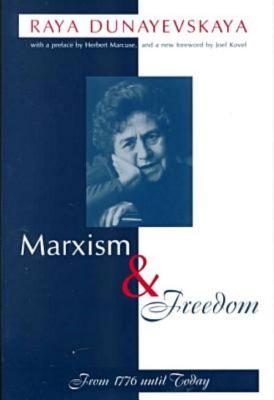
published in 1975 by Pluto Press
notes written in 2017 for a grad school comprehensive paper on social movements
Dunayevskaya argues for the primacy of ‘the self-activity of the masses,’ making this the root of her humanist philosophy, her understanding of key Marxist concepts (and the method by which these key concepts were elaborated), and her reading of Marxist and Soviet history. It’s a dialectical theory and method that puts working people at the center and, in doing so, heavily critiques bureaucracy, state capitalism, and vanguardism.
Dialectics
Dialectics is central to her conception of humanism, as everything revolves around the tension between potential and limitations. She sees dialectics as self-movement caused by contradiction within internal relations: Each thing has internal contradictions, which causes its movement, and the proof of dialectics is in this practical, historical movement, and not in its ‘proofs.’ So we see how capitalism creates the conditions for an end to scarcity (potential) by perpetuating scarcity (limitation). This contradiction shows that class struggle is the motor of dialectical humanism, as capitalism is both the concentration of capital (limitation) and the socialization of labor (potential). Capitalism creates qualitatively new forms of cooperation while being terrified of what it has achieved. Humanist political economy measures the current situation of concentration and socialization (primarily by investigating the relations that produce alienation/dehumanization, such as division of labor, the domination of living labor by dead labor, socially-necessary labor time), while philosophy explores our future potential (of workers to expropriate the expropriators, end the division of labor between thinkers and doers, and create a new society). Class consciousness is our awareness of this potential and also of how the potential is suppressed.
This all adds up to Marxism as a grand, expansive vision for humanity, but stemming from the concrete, focused necessity of human labor. Throughout it all, she returns to the refrain of ‘masses as reason’: Marxism is the theory of the daily lives of workers; and it’s an idealism whose ideals are already present in practice. This means investigating how workers are struggling exposes the concepts we need to understand their struggle, and we should recognize when we’re caught off guard by workers’ resistance, as this means it’s imperative to re-organize our thinking.
Lessons from class struggle
She goes on to show how class struggle/the working day, cooperation/fetishization, constant and variable capital, and the falling rate of profit are all key Marxist concepts that come from an attention to workers’ struggle. In each example we see how class struggle causes historical development.
1) The US Civil War gave workers an opening to fight for the eight hour day, which showed Marx that the working day was the result of centuries of class struggle. He therefore centers the working day in Capital, thereby making it a history of production instead of a history of theory (eg, beginning with a debate with Ricardo). This makes Marxism into a theory of working class struggle.
2) The Paris Commune taught Marx that workers lose skills to machines while gaining the skills of cooperation. The Commune was the first instance of worker self-government, showing Marx that fetishization is historical and can be undone by creating new social relations (of state, market, production, and property). Fetishization is the ideological opiate hiding cooperation, while in reality the capitalist revolution is the creation of labor-power: its qualitative development of social labor, instead of a mere quantitative increase in waged labor.
3) Outbursts of machine breaking showed him the struggle of living versus dead labor. Indeed “capital” is the accumulation of dead labor (machines, constant capital) over living labor, and the capitalist uses the mortal conflict between dead and living labor to their benefit. While the boss has to enforce absolute surplus value extraction, machines enforce relative surplus value extraction. On the other hand, increasing accumulation by introducing constant capital or reorganizing production demands a worker who can perform many social functions, which is a threat to capital.
4) Workers’ resistance to Russian state capitalism teaches us about the falling rate of profit. Using dead against living labor degrades workers, increases unemployment, and heightens capitalist contradiction, and the Russian experience shows no amount of planning will avoid this. Instead of being socialist, the USSR practices state capitalism and is subject to the falling rate of profit. The only answer is worker control over value production.
History
Finally, she walks us through the history of the Second International, the Russian Revolution, Lenin’s strategic development, and Stalin’s counter-revolution. 1) Marx’s First International was dismantled with the Paris Commune, and the Second International was led by the German social democrats, with Kautsky as their leading theorist. They converted Marxism into catechism, advocated for a progressive capitalism, and focused on training managers for the moment capitalism collapsed (instead of following concrete workers’ struggles like the Russian soviets in 1905). Its downfall was in supporting belligerent governments during WWI, and its legacy is found in the labor aristocracy that has disciplined the working class.
2) The Russian soviets’ goals were totally alien to those of social democrats: they self-organized without a vanguard (‘spontaneously’), increasingly functioned as a parallel government, and sought to seize power and appropriate the property of the plunderers. Recognizing that the soviets caught him off guard in both 1905 and 1917, Lenin was increasingly against vanguardism. He increasingly shed his Kautsky-ist attitude to the party (we need more organization so we can seize the crisis), seeing his vanguard wasn’t disciplined enough to realize how the masses were outpacing them, that the soviets were the leaders and were destroying bureaucracy to cause the state to wither. This shows Lenin that, instead of promoting bureaucracy (as Trotsky did), the workers self-organized to protect themselves from the state. Therefore, drawing all workers into administration is the only way to create new social relations. The unions should be schools of communism, and losing connection to the workers (as bureaucratization does) can only mean approaching the bourgeoisie.
3) Stalinism was the culmination of this bureaucratic counter-revolution. It began with the fetishization of plans that grew the management class, and then moved to forced collectivization, slave camps, abolishing unions, Stakhanovite speed-ups, rescinding the constitution’s commitment to abolishing the state and classes, purges of all party members with historical memory of the revolution, a growing organic composition of capital, capitalist competition on the world market, minimum pay and maximum extraction, and terror. Stalin was the perfect counter-revolutionary class enemy, showing capitalism is so corrupt that it can only win by pretending to be other than what it is. However, resistance in East Germany, Hungary, and the Russian work camps show that totalitarianism will fall. While similar things are happening in the US (unions are dedicated to supplying labor to capital under collective agreements, automation and speed-ups cause dead labor to dominate the living, and the New Deal is more planning to save capitalism), workers are resisting in the Detroit factories and Appalachian mines. The Black struggle is an example of revolutionary self-organization.
Genealogy
While she’s writing well before the watershed year of 1968, Dunayevskaya’s critique of Russian state capitalism and business unionism is a precursor to arguments that would gain much more force later on. But instead of rejecting class in favor of identity, she argues that Russia and the AFL show the necessity of worker control over production and fighting against bureaucracy.
New social movement theorists would critique the lack of attention to culture in her analysis, but there’s also a lot here to celebrate (primarily, her humanist methodology for engaging in dialectics and developing Marxist analysis). She paints a picture of social movements fighting for control and making history in the process, versus both the bourgeoisie and counter-revolutionary projects stemming from bureaucracy (which is the constant threat in her history). And each time there’s a defeat (the Second International’s support of inter-imperial war, Russia’s decent into a totalitarian party-state), she urges us to go deeper and lower, just as Lenin did when he recognized the soviets were far more progressive than his vanguard (although Dunayevskaya seems to go to great lengths to align herself with Lenin, against Kautsky, Stalin, Trotsky, and Mao). Faced with automation and business unionism in the West, new social movements sought to do the same- focus on the subjects that had been excluded and build democratic production and politics from these spaces.
There’s also a longer-term genealogy that appears, as workers fought during the 1800s against absolute surplus value extraction through the extension of the working day and then increasingly against relative surplus value extraction via automation and Taylorism. Hardt and Negri would argue that today’s struggle is against surplus value extraction through control of cooperation, but it’s unclear whether this is indeed different than the other two forms of extraction. Uber and cleaning Airbnbs seems to be piece-work, more than novel forms of cooperation. Coding and design definitely involve new forms of cooperation (exemplified by collaborative digital platforms), but is this simply collective piece work too, where teams are working one product at a time and extending their workday to survive? Also, these are very small sectors of the economy. What’s needed is a more detailed mapping of what sort of production people are engaged in and how value is being generated, instead of conjecture that celebrates people’s favorite concepts. You also need a more detailed understanding of how ever-more value is squeezed from people in these situations. Is it an extension of the workday, freezing wages, and reducing overhead? Is it through technology that increases the pace of work? And are new forms of collaboration indeed different from new forms of technology? (For example, Harvey considers production relationships as a technology also.)
Class consciousness
‘Self-activity’ is a key concept for Dunayevskaya, but she doesn’t get into much detail about its genesis or how to increase it and articulate it. She’s against a vanguard assuming it should lead the masses, and she has great faith in the ability of working people (collectively) to determine key aspects of capitalist oppression and to fight against them. But, instead of seeing it strategically, this ‘self-activity’ is simply a given. In discussing Lenin’s opinion that anti-colonial, nationalist struggles provide the working class new ways to come together against capitalist fragmentation, she acknowledges that the goal is for a class to articulate itself. And in critiquing bureaucracy, she acknowledges that the class must develop its capacity for collective self-government instead of relying on a separate body. Yet the process of all this coming together is missing.
Strategy
While she’s sparse on this, bureaucracy is a huge factor limiting class consciousness. Fetishization is the primary limitation to understanding social cooperation, and bureaucracy is a form of organization that fetishizes its plans and creates a new ruling class of managers. This is especially dangerous when the bureaucracy considers itself a socialist one. Against all this, we need to organize against the primary ways capitalism is tightening the screws during this stage of historical class struggle. Workers showed us this was via lengthening the working day in the 1800s, through automation in the post-war US, and through bureaucratic planning in Russia. We have to look for the ways people are resisting ‘spontaneously’ (that is, without fulltime radicals coming in and organizing them), ask what that means for the way capitalism is operating today, and organize around these conclusions to heighten them. We’re limited in this to the extent we engage in fetishization, ignore the workers, or remove ourselves from them.
Concepts
Humanism, Marxism, class, class consciousness, dialectics, praxis, labor, social relations, state capitalism, alienation, ideology, bureaucracy, revolution, spontaneity, subjectivity, vanguardism
People
Marcuse (wrote the foreword), Trotsky (against, for advocating socialism as public, state-managed property, bureaucratization), Stalin (against, because he’s the worst), Mao (against, also for state capitalism), CLR James (collaborator), Kautsky (against, for exemplifying the problems of the Second International)
 Stuart Schussler