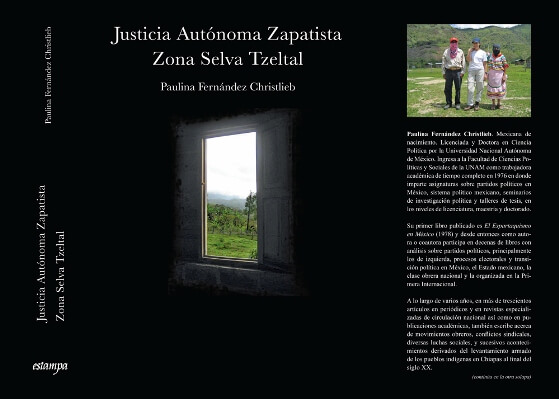
published in 2014 by Estampa
notes written in 2017 for a grad school comprehensive paper on autonomy
Using extensive quotations from primary source interviews, Fernandez explains Zapatista justice in its widest sense, as a practice fundamentally rooted in the collective ownership and work on the land and a practice that is tied to all aspects of autonomy. This is the message repeated throughout the text: the official justice is money and autonomous justice is collective work on collective land. She begins with testimony contrasting current justice and autonomy to slavery and coercion before the uprising; she then situates the fundamental change in the land; she explains self-government and cargos, emphasizing the collective approach; she then (and only after these important explanations) describes the justice system in more detail; and finally mentions its current limitations and how justice-as-education is central to continuing to transcend obstacles.
Indigenous peoples’ situation before the uprising was the same across plantations, as practices were homogenized to prevent people from leaving one plantation in search of better conditions at another. There was hereditary debt, no freedom of circulation, no pay (until Cardenas, when people began receiving a few cents for 12 hours of work), people had to complete the boss’s work before doing farming their own fields, and they couldn’t even sell their animals without paying a tax of 10-50% to the boss. ‘Justice’ was the violence and terrorism that sustained this slavery. It was based on white supremacy, as any kaxlan (tseltal word for white person) could order any indigenous person, as if they were their boss. The boss’s overseer was the executor of justice, who would whip people in the fields, deny them food, send them far away for unpaid jobs, or make them carry things hundreds of kilometers, frequently killing them. They would kill people as punishment at will. Rape was a punishment, but also the ‘right’ of the boss, especially with women wanting to marry. ‘White guards’ were another organized form of justice. There was absolutely no access to government justice. Instead, indigenous contact with the government was limited to women sent to the municipal president, families of murder victims jailed when they arrived to denounce the crime, the military burning towns attempting liberation, and free labor rented out from plantations to the government. Today, official justice is ‘accessible’ to indigenous people but is similar in essence: it’s discriminatory, only conducted in Spanish, costs money, justice can be bought, and crimes are frequently fabricated.
Land
Before the uprising the bosses owned the land and therefore owned those who lived off the land. The stark and enormous achievement of Zapatismo was dispossession of the hacendado class (which is as severe as the ‘dictatorship of the proletariat, but also was far as the dictatorship part went). Collectively owning the land now allows the Zapatistas to collectively control their destiny. Collective land allows justice to be taken off the market that government justice is on. Often this is quite literal, as specific plots produce what becomes the resources for autonomous justice. So owning land is what allows them to control their work and production and to dedicate it to autonomous health, education, housing, and collective work. Generating their own resources allows them to determine the rules and means of organizing these resources.
Self-government
Looking at self-government, land is a central concern for many autonomous authorities, showing us that ‘justice is about the land’ because collective work is a constant dialogue that’s worked out through the different aspects of the justice system. The very structure of justice and autonomy (like which positions exist and how they’re chosen) is also determined by the land in that it’s locally-specific. Furthermore, boundaries and borders are the primary focus of local authorities, and each town has a comisariado team tasked with this. The agente resolves general disputes, but works so closely with the comisariado that they’re almost indistinguishable. Just as the land has been removed from the government and political parties (who are nothing but transmission belts for neoliberal capitalism), self-government receives no money from the government or parties. It’s opposite on this fundamental level, and all its specific aspects are also mirror images of how representative politics function.
Aspects of the cargos are that:
-authorities are only nominated by the community at large, who considers the quality of their character and commitment to the Seven Principles;
-being able to write and speak Spanish isn’t a requirement;
-voting is done publicly in assembly;
-these elections occur differently in each town and municipality and are for different positions in each;
-the ‘positions’ are filled not by individuals but by committees who work together;
-the authorities don’t set their own tasks but ensure the work mandated by the assembly is carried out;
-they investigate claims for justice but the community decides and administers;
-there is immediate revocation, especially for failure to account expenses and carry out assembly mandates; and
-there are no lifetime authorities, especially since the work isn’t paid and people have double work with their responsibilities at home.
In sum, collectivity is central in all instances: there is collective ownership of land, collective work, collective agreement on who authorities will be and what they’ll do, collective self-government (generally and via committee work), justice is decided collectively, punishments are usually collective work, and gossip and lies (which harm collectivity) are transgressions the justice system frequently takes up. When authorities are chosen, they vow to respect the will of the assembly, and the assembly vows to participate in the tasks the authority administers (mandar obedeciendo). Collectivity also connects justice to issues of education, because if justice is the process of resolving disagreements about collective work, it’s also the general education of how to live collectively, through passing along historical memory of plantation life and the uprising, learning about Zapatista principles, how to live a good and healthy life, how to not fall victim to the government or money, and why not to leave the organization for a bag of cement. It comes back to the overall message of staying on the land.
Autonomous justice
As for autonomous justice specifically, it’s inseparable from democracy:
-the people decide who will impart their justice and what reglamentos will guide this politics;
-justice is used to resolve problems and transgressions between members of this democratic polity; and
-it’s also used to sort out the daily disagreements arising from collective work, how its distributed, and how to accommodate those unable to participate in it.
The goal is always agreement and conciliation, whereas official justice seeks ‘legal truths’ but just ends up masking inequality. Once again, whereas official justice is indistinguishable from money, autonomous justice is indistinguishable from collective work. So in autonomous justice, each assembly creates the reglamentos that guide autonomous justice, and the majority of issues are resolved simply by clarifying a reglamento or writing a new one. So justice is the process by which collective work is decided.
In contrast, at the Junta level justice is primarily the defense of land from invasion. The local justice process frequently concerns issues of production (burning fields, lumber, fishing with bombs) or of reproduction (domestic violence, drunkenness, sexual relationships between unmarried people, divorce). Authorities convoke the parties (parents in cases of relationships and divorce, the assembly for grave issues), get testimonies, and investigate if need be. Once both sides have agreed to a resolution, they draw it up into an acta and collect signatures.
Justice is also open to non-Zapatistas (which ends up being most justice work) and shows them the benefits of autonomy. If this involves other organizations, the authorities consult the leaders of these organizations and, for example, convince them not to support their members’ invasions of Zapatista land, thereby seeking conciliation with neighboring indigenous groups, unlike zero collaboration with the government. However, if the issue occurs outside their jurisdiction they can only advise.
Obstacles
Limitations of autonomy and justice also begin with the land: there is ongoing invasion by rival groups, stoked conflicts on ejido councils including both Zapatistas and non-Zapatistas, and ecotourism projects. There are economic programs built to foment desertion and people who want to keep their land after they desert. Internally, there are people who promote capitalist commercial practices or who want individual title. The fruits of collective work still have to be sold to coyotes, as transporting them is a challenge. There’s also deep sexism, from religion, from government, and from pre-existing sources. Sometimes authorities burn out before training their replacements, or promoters who have served a long time burn out. And finally, investigating justice claims costs money (especially when they’re made by non-Zapatistas and this work is essentially a subsidy to bad official justice). This keeps authorities from building internal autonomy and from the justice claims of Zapatistas, and sometimes priistas only use it because it’s free (while remaining committed to their ideology). Nonetheless, people are committed to justice remaining open and free.
Autonomy
Autonomy begins with collectively-held land. It’s the development of collective work projects on that land to sustain the people, and this requires self-government to work out. Justice is central to all steps: regaining the land is indigenous justice against colonization, the projects allow people to reproduce themselves, learn, and stay healthy with a sense of justice instead of humiliation, and self-government is the process of dialogue by which people practice justice with each other. You have layers of material embeddedness, beginning with the land, moving to collective production, and then the layer of social fabric. Finally, there’s the level of a culture of justice, of the collective memory that passes along shared principles and historical struggle, the education about ‘living a good life’ that one generation must teach the next.
It’s important to spell this out since it’s so fundamental and so foreign to us here in the tertiary sector (we’re so removed from the primary sector that we forget it’s the basis for the urban economy we see around us, making us think we can do without it). Without land there’s no collective production. Without collective production there’s no support for autonomous health and education. Contrast this with many collectives, affinity groups, and prefigurative practices that are only concerned with autonomy as a stance towards parties and the government, plus decision making process. There isn’t a social fabric, let alone production or land. No wonder it often falls into individualized critique. Therefore the land question is the heart of the difference between urban and rural autonomy. Without it, we can’t climb up the ladder of self-determination. But in the city, without land, we still benefit from others’ land bases, which means that being oppressed in the city (especially a city in the global north) is generally nowhere as bad as the pre-uprising slavery Zapatista elders describe.
So autonomy must be embedded in space, production, and society, and the second point is that it must have a politics. The plantation owners were ‘autonomous’ too, in the negative sense, as they ruled like feudal lords without any accountability to state or even municipal government. So autonomy must be decolonial and anticapitalist.
The book is an exploration of the practical anticapitalism of autonomous justice. Those interviewed don’t critique liberalism and elaborate autonomous justice on juridical first principles. They have a culture and land that constitutes this worldview, and the justice system is thoroughly anticapitalist in the way it works day to day, which is the most important way to be anticapitalist. The contrast between official justice with autonomous justice is the contrast between capitalism and community-centered distance from it. You can go line by line through Fernandez’s description, from the simplest processes to the broadest implications, and all of them are a mirror image of the official justice system. One justice says ‘do what you want as long as you don’t hurt me,’ and the other is about conciliation and building community self-determination. The basis of the one is private property of dispossessed land, and the other is collective work on collective land. One does the coercive work of maintaining class society and the other does the work of building the class as social relations.
And this is another way to understand social relations, as everything the autonomous justice system sets out to strengthen. Domestic relations, marital relations, production practices, collective work relations, choosing self-government authorities, doing education, doing healthcare, and relations with other groups – these are both the issues autonomous justice takes up and the social relations of the community.
Understood this way, justice is the intentional process by which we build our social relations as we’d like them to be. Most social relations are built and reproduced implicitly, but ‘justice’ is the boundary zone where we decide to make it explicit and intentional. Most disagreements are mediated through these relations, and it becomes a ‘justice’ issue when there aren’t adequate relations, processes, agreements. ‘This is where we’re going to collectively draw a line in the sand.’ For official justice, it means extending the boundaries of defense of class society by prosecuting los abajos for petty theft and putting them in jail. It’s about systematically destroying egalitarian social relations and replacing them with coercive ones. As Gramsci says, justice is where coercion seeks consent. But the root is nonetheless coercive. For autonomous justice it’s working out the finer details of collective work and distribution of resources, amidst all the diversity and difference this takes on according to the people and the land.
Schools of thought
Self organization is about the projects level, without the land (prior to it) or self-government and justice (after it/a practice making it qualitatively richer).
Operaista refusal misses all of this, instead focusing on how antagonism drives the capital-labor relation. Autonomy is what we build from our ‘exodus’ from the capital-labor relation, which is why land is fundamental. That’s the nugget of the exodus.
Stuff on the commons tends to miss all the practical, strategic, grounded specificity by calling it all ‘commons’ and departing towards more theoretical questions.
Decolonization gets at everything that’s bad about ‘official justice,’ but autonomy shows what decolonized practice looks like. This is the movement from critique to proposal, and beyond even discursive proposal, to building alternatives. The Zapatistas surely engaged in a massive decolonization, but their biggest project has been re-communalization.
Relation to other concepts
The book shows we can’t get hung up on the relation to the state. The state isn’t going to be reformed to be a local, land-based, empowering, productive, collective practice of creating conciliation. That is to say, it’s not going to nurture and build social relations of liberation. So why make it our priority to influence something that ultimately will never be more than a halfway measure for liberation, something that can provide resources but not self-determination? Why not put our limited energies into something that’s directly beneficial and self-perpetuating?
Ecology- We see that justice is about ecological production and reproduction. Given a collective land base, we can’t produce as capitalism would and must seek social and ecological harmony and justice. Capitalism can ignore its depravity by moving riches to a different place than their extraction and production, by leaving a place once it has been sacked. Autonomy is rooted in the land and its community and must build equilibrium among them. Autonomous justice is social justice is ecological justice. How we treat the environment is an extension of how we treat each other.
Settlers treating each other with justice is a first step to building just relations with the land and its original stewards. The issue is that collective ownership of the land is fundamental to touching off this process, so you have to take on the basic question of whether non-native people can own colonized land. Because without collective ownership and collective production, we can’t form the self-government that will allow us to build respectful, non-extractive relationships with indigenous peoples, of the type laid out in the original treaties. And I guess the lesson from the treaties is that we are indeed allowed to be here, but not to perpetuate capitalism and colonization. So maybe ‘collective usufruct’ (instead of ‘ownership’) is legitimate and can be the basis for greater liberation.
Concepts
Autonomy, Zapatismo, dispossession, reproduction, dispersion
 Stuart Schussler