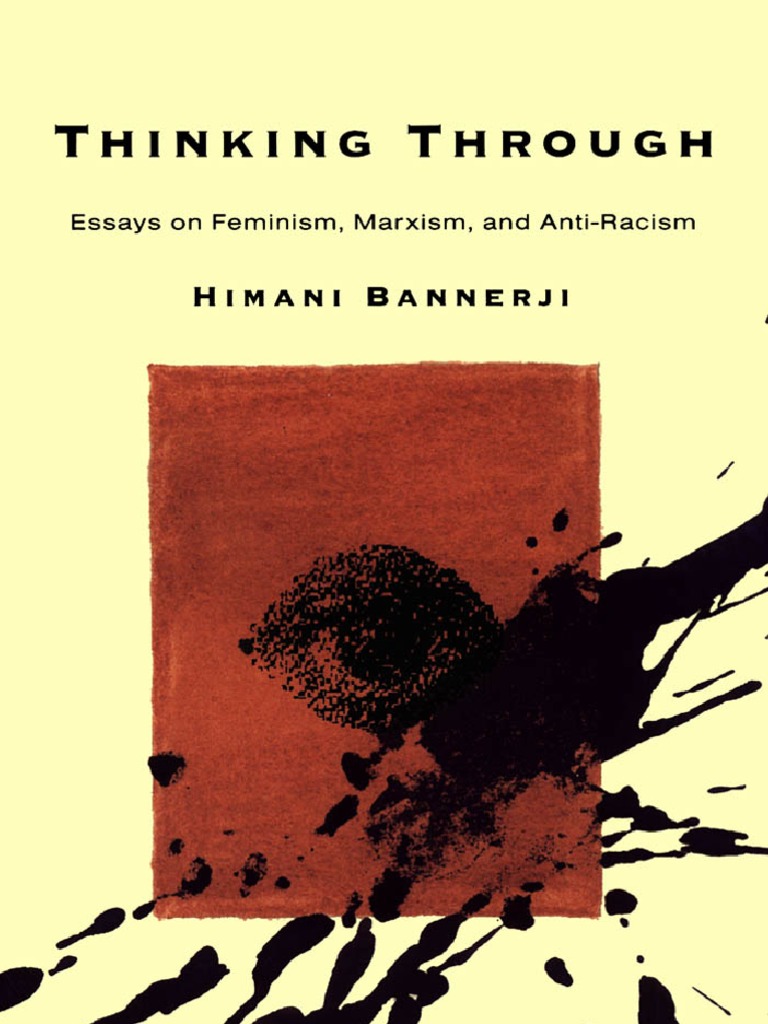
published in 1995 by Women’s Press
notes written for a grad school comprehensive paper on social movements
This is bound to be your definitive reference on questions of revolutionary subjectivity, identity, and the praxis of thinking about these things to make social change. It’s extremely theoretically rich, as she re-orients the identity discussion towards concepts of experience, difference, social relations, relations of ruling, and subjectivity. The analysis dialectically brings together Foucauldian cultural, knowledge/power thinking with Marxist thinking on revolution and social class. In doing so, it’s a prime example of how to carry out a dialectical analysis. In fact, it’s a case study of dialectics as applied to identity. (And for this reason it’s quite hard to summarize, so you’ll probably still need to go back to the notes.)
Identity and relations of ruling
She begins by noting that learning about racism, patriarchy and class isn’t simple “identity politics,” but a process of naming one’s world that allows us to find ourselves and also connect with other struggles. This integrative approach (liberatory naming helps us understand social relations and build a broader revolutionary subjectivity) is in opposition to the liberal approach of breaking social ills into pieces, ranking them, choosing representatives and gatekeepers for each, separating each community, and ultimately forming subjects who can be made to act according to these identities. To gain representation or claim agency, you must advocate for your prescribed identity (which has worked very well for groups that have ‘become white’ or accessed power). This amounts to being offered agency on very inauthentic terms. White identity works the same, but with the key difference of being implicit and going under the name ‘humanist universalism’ whereas all other identities are made explicit. This reified, distorted representation was a tool of colonialism and slavery. It replaced subjectivities that had actual substance (like being of the Bear Clan, for instance) with negative, reified ones that distinguish between the rulers and ruled and dictate the terms within which the ruled can seek to better their lot. Relations of ruling are based on the imposition of names that aren’t of our own choosing. Naming establishes difference, and difference allows the distancing from power necessary for exploitation. Historically, this process of naming allowed specific ways of ‘doing capitalism’ and ‘doing imperialism’ (the relations of ruling). Bannerji’s method is to treat this all concretely and historically to see how identity has functioned as a social relation (and not as individualist experience, transhistorical, or as an abstract concept).
So naming and difference allow for ruling relations (which are a type of social relation). Alongside the focus on naming, feminism has taught us about ‘ways of seeing’ that produce relations of ruling through knowledge/power. Ways of seeing (interpretive modes, ideology, the everyday practices of knowledge production) establish producers’ knowledge (for the rulers) and consumers’ knowledge (for the ruled). This knowledge/power is how agency is produced; it’s the production of a subjectivity that allows social relations that allow exploitable social production. This is all really jargony, and my task is to understand it well enough to integrate it into my research and organizing. The basic point is that social relations are created through naming and seeing, through identity and knowledge.
Revolution and becoming
In opposition to all this, there is the revolutionary and integrative approach. Here Bannerji puts the emphasis not on (static, reductionist, isolated) ‘being,’ but on becoming. Instead of the powerful naming the other, we collectively name ourselves as to create ‘actionable names’ to aid in this becoming. This requires a dialectical approach: the everyday, experience, and cultural (related to identity) comes together with class, ideology, and the historical materialism of capital. So we avoid both cultural reductionism and class reductionism with a dialectical approach. And instead of limiting ourselves to focusing on discursive constructions, we must look at historical social relations. So not just ‘imagined communities,’ but the concrete, historical processes by which real ones have been formed. Just as we flip oppressive naming on its head (we resist negative identities by creating direct representation based on collective self-naming), knowledge/power should be flipped by revolutionaries who subvert the relations of ruling based on the production of a ruled agency and replace it with revolutionary agency that relies on the direct production of knowledge for a validating subjectivity.
Therefore feminism teaches us about revolutionary knowledge/power and intersectional identity teaches us about positive forms of difference. This positive difference is not solely based in the experience of oppressed individuals: instead there is a dialectical perspective that considers experience as inseparable from its context of social antagonisms. We must map these antagonisms so that experience can be understood within the entire social organization it’s part of. This is the method of ‘mediations,’ in which we simultaneously, dialectically consider the concrete and its many social relations, the way something is both specific and general, seeing it from both the perspective of experience and from the social. Dorothy Smith argues that experience is a set of disjunctive social relations (not absolute truth), and our task is to interpret them – in ways that build revolutionary subjectivity.
Genealogy
By exploding the identity-versus-class debate that artificially divides between new and old social movements, Bannerji helps us see that all these movements are trying to build revolutionary subjectivities by naming themselves and gaining a knowledge of the world/way of seeing that makes this subjectivity actionable. They just do this around different historical, concrete articulations (in specific places, with their racial, gendered, and class dynamics). Like Cox and Nilsen say, their strategic orientation grows out of this. The point is that, instead of applying broad categorizations to these movements, we must understand them as concrete historical processes. What specific groups mobilized in Seattle, who were they made up of, and how did they come together? What about the different Occupy groups? Instead of looking for commonalities in discourse among anti-neoliberal groups or immediately calling Occupy “transnational” (which instantly hides more than it elucidates by saying it’s from ‘everywhere’), this sort of analysis is relentlessly particular while also being relentlessly contextual. It refuses to make generalizations until this has all been developed, which makes for good strategy but is too painstaking and collective for academics who want to pound out conference papers.
So what strategic orientations have been predominant in the left over the past one hundred years? Read against Bannerji, this is much too broad of a question, and I doubt it’s useful for building revolutionary subjectivity. If you’re trying to build subjectivity among new social actors in North America, it’s better to look at the strategies of the Latin American solidarity movement over a few generations, especially as they overlapped with the labor movement, civil rights and Black Power, anti-imperial guerrilla resistance, the dictatorships, feminism, resistance to neoliberalism and Occupy. How have people named themselves in relation to these movements? What sorts of understandings have they sought to build? And how have they mobilized these into action? These are important aspects of ‘strategic orientation’: 1) how the ‘we’ carrying out the strategy is constructed, 2) the reflection this we engages in (how they relate experience to social antagonisms), and 3) what actions this reflection and identity construction leads to.
Class consciousness
Her discussion of difference and relations of ruling provide you with a direct connection between class consciousness and social movements. There is the negative difference used when people are named in ways that facilitate their distancing from power, which both creates exploited classes and obfuscates them through its isolated, managed forms of representation. This is how difference creates relations of ruling. On the other hand, there is positive difference- people recognizing they have been made different to be exploited and purposefully acknowledging this difference and naming themselves in ways that create revolutionary alliances. These are revolutionary, liberatory social relations- relations of freedom. So Bannjeri shows us that forming class consciousness is about building a revolutionary subjectivity, building knowledge/power, and putting it into action. Class consciousness (another way of saying ‘building subjectivity’) is building the social relations that allow social movement. Just like Ollman says, this is a collective process that brings together the subjective and objective (whereas identity under relations of ruling is about isolation, being static, only considers the subjective, and purposefully ignores the objective). So class consciousness and social movement are about overcoming all the hegemonic weight put into creating a confused and ruled ‘I’ and forming a rebellious ‘we.’
Strategy
Bannerji does important conceptual work helping us get past unhelpful debates about whether ‘identity is a strategic dead end,’ and she does this by shifting the conceptual terrain. Her focus here isn’t on specific strategies for how to build revolutionary subjectivity, apart from some general considerations: this process must be dialectical (it must bring together experience and social context), it must be collective, and it must be concrete (referring to particular groups in particular places with particular histories). I would argue that, the stronger hegemony is (if there’s more political and cultural effort put into dividing people into isolated and managed identities, plus more economic effort put into forming a bloc whose general material interests are served), the harder it is to build revolutionary subjectivity. The strategic question is What specific ways have North American groups overcome these obstacles, and what new opportunities are there this day in age? I recommend you find a way to incorporate this into your research by making it into specific questions to ask the focus groups.
Concepts
Epistemology, identity, neoliberalism, liberalism, popular education, dialectics, everyday life, difference, subjectivity, social relations, methodology, revolution, spontaneity, knowledge/power
People
Fanon, CLR James, Cesaire, Thiongo, Achebe, Black Panthers, Dorothy Smith (relations of ruling), Angela Davis, hooks, Gramsci, Spivak, Eric Williams
 Stuart Schussler