final paper for a Cultural Studies class on the everyday
2015
Murals abound in the Zapatista caracol of Oventic. The caracoles (literally, conch shell or spiral) are centres of autonomous government for the surrounding indigenous, peasant Zapatista communities. Their one-storey wooden structures are home to womens’ artisanal cooperatives, assembly spaces, offices of the municipal and regional levels of Zapatista self-government, medical clinics, and computer labs featuring dial-up speed internet. The institution that consistently hosts the most people is Oventic’s secondary school, where a few hundred Zapatista youth live during the weekdays and learn in both Spanish and Tzoztil languages. The school is covered in dozens of murals – nearly every square inch of the seven buildings that comprise the campus. Typical of the confused romanticization that has long been foisted upon Zapatismo, images of these murals abound on the internet, yet most of the “Zapa-tourists” who post them mistakenly attribute their authorship to the Zapatistas.
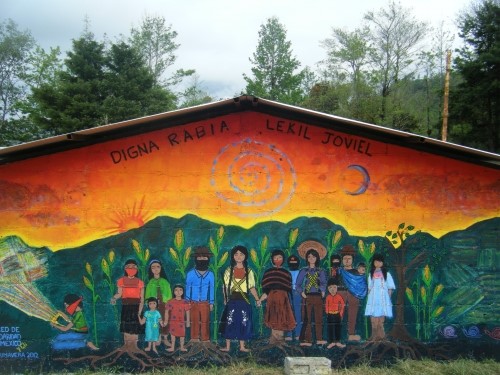
The truth is that most of the murals were painted by North American student-activists who spent one or two months in Oventic at the Zapatista language school through the Mexico Solidarity Network’s study abroad program. In typical Freirian style (1999), the language school teaches student-activists the philosophy, history, and practice of autonomy through Spanish language instruction. Given the cultural divide between their indigenous hosts and the international visitors, not to mention that almost all Zapatistas speak Spanish as a second language, daily interactions between students and their hosts in Oventic are many times awkward. Yet their murals – with common references to women’s leadership, the liberation of land/ecology, and corn and weaving as metaphors for resistance– represent the powerful inspiration of having visited liberated territory. One of the most powerful symbols is the caracol or spiral, which rejects linear progress in favour of the slow, circular expansion necessary for transforming all aspects of everyday life. Rather than pursuing the capital-R Revolution, the caracol is the strategy of “questioning as we walk,” of action and reflection, of a reflexive methodology in pursuit of liberation.
The North American students’ murals are odes to autonomy, the everyday practice of disalienation in both social reproduction and social wealth. Alienation is the violent, yet normalized separation of people from the objects, relationships, and capacities they produce, and it is the feeling that these alienated creations have power over their producers, that people’s lives and humanity are split between service to alienated objects and moments of fleeting, hollow freedom. Disalienation is the opposite of this. During their weeks spent in Oventic, the students see how autonomous agriculture means collective production on reclaimed land. The food produced directly feeds members’ families and is carried in their children’s knapsacks as they head to school. They see how education is administered by “promoters” chosen by their communities to teach self-government and pride in indigenous culture. They see how this self-government is carried out through community assemblies and administered by leaders who receive no salary for their work. Compare all of this to plantation labour prior to the 1994 uprising, when indigenous peoples were held in debt bondage and outright slavery; curricula developed in a far-away capitol imposed cultural subjugation and prepared students for either prison or menial labor; government collected taxes for their immediate enrichment and to finance the adminsitration of privatization. In their murals, the visiting students celebrate this disalienated unity of ends and means, this “communal luxury” (Ross 2015) with images of people as corn, people as land, and generations of men and women together in struggle. Seen as wish images, the murals represent ideals of solidarity, the commune, and celebration.
After a few frantic weeks of painting amidst bouts of fog and rain, the students present their art to the Zapatista teachers and students they have sought to represent and then return home. The tearful departure leaves them full of inspiration, having seen the possibility of people working, deciding, and learning on their own terms. They are eager to spread this seed of hope, but how to make it grow in a concrete jungle? How can they replicate their experience back at home, where they often lack the dense social fabric, control of land, and long-standing self-government practices that make Zapatismo so powerful? How do they begin to practice autonomy in a context of profound alienation? After they return to their alienated everyday lives, their mural becomes yet another alienated object, confronting later visitors who see it as Zapatista art. As they return to their collectives, groups, and organizations, they are confronted with the practical dilemmas they could forget while in Oventic. Now, the tensions return between individualism and collectivity, between spontaneity and organization, between inwards, prefigurative development and outwards, strategic action. How do the students attempt to overcome this separation between their aspirations and reality? Returning to the metaphor of the caracol, how do they question as they walk if they have no knowledge of the terrain, much less a path?
My doctoral research asks this question of how North American student-activists bring Zapatista-inspired autonomy back home. Beyond the dreams of their murals, they must build this autonomy in the everyday. Following Lefebvre, “Either man [sic] will be in the everyday or he will not be at all. He will live his everyday life by superseding the everyday life he lives today, or else he will no longer be. As long as everyday life has not radically changed, the world will be the same as ever. It is up to the radical critique to bring those changes to the world!” (2002: 24).
The same can be said of everyday autonomy: its caracol must envelope the everyday or it will not exist at all. Through this essay, I will use the Zapatista principle of “questioning as we walk” to develop a methodology for understanding these student-activists’ efforts. As a methodology is an approach to research, I will prepare this approach as one would prepare to hike through the hills. First, we must become familiar with the terrain: the everyday. Second, we should focus in on key aspects of this terrain, its hills and valleys. Here, these key features are the “three hills” of alienation, social reproduction, and regimes of power. Third, we need tools for the hike, our boots and walking stick. These will be the privileging of certain everyday spaces, Benjamin’s dialectics of seeing, and Lefebvre’s theory of moments. Finally, we must set our guideposts for the hike, specific methodological cues to aid in investigating everyday autonomy building. Together, these steps prepare us to learn how the dreams of the mural come alive in the everyday.
Defining the everyday
First, we must define a term that, at first blush, is completely innocuous. In this section I approach the terrain of the everyday as both a field of tension and key to understanding social transformation and continuity. I will then show how theorists employ this lens to answer economic, cultural, and political questions.
The everyday, the normalcy of routine, the daily interactions that are the stuff of our conceptions of and interactions with the world. Instead of experiencing “working class consciousness,” we have passing conversations with coworkers. Instead of experiencing “commodity fetishism,” we see where the market has moved today. Instead of “the dialectics of domination and resistance,” we get back at the boss for not giving a raise in ten years by stealing office supplies. The everyday is the level where structure either finds or loses its traction, where authenticity lives and dies (Lefebvre 2002: 24).
How to focus in on something so particular and come to any generalizable conclusions? First, the everyday is a field of tension, however ambiguous the veneer of normalcy may render it. “The everyday offers itself up as a problem, a contradiction, a paradox: both ordinary and extraordinary, self-evident and opaque, known and unknown, obvious and enigmatic …. If the culture of everyday modernity does evidence the process of making the unfamiliar familiar, [those writing about the everyday] work to defamiliarize this condition. In attempting to make the everyday vivid, phantasmagoric representation is replaced by practical, poetic and critical operations” (Highmore 2002: 16).
Lefebvre makes a similar point when he defines the study of everyday life as a critique of History that focuses on the gaps between intentions, actions, and results (2002: 20-22). The study of everyday life thereby turns structuralism on its head. Instead of seeing these gaps, aberrations, problems, and paradoxes as discontinuities within an otherwise solid structure, the discontinuities themselves are our building blocks for making broader generalizations. Focusing in on this tension between extremes, Highmore urges us to undertake a dialectical double movement: on one hand to question that which is usually taken for granted in everyday routines, to find what is peculiar yet assumed to be normal, and on the other hand to critically relate it to what I call “regimes of power” such as modernity, capitalism, and biopolitics. We must critically engage the everyday on its own terms while critically relating it to the structural level.
Bringing the structural and the everyday together in a context of tension allows us to better understand social transformation. Early theorists of the everyday such as Simmel and Benjamin engaged in this dialectical analysis to understand how modernization’s creative destruction of people’s habits, desires, and political and economic systems came about despite their participants’ feeling of normality, that each year was essentially the same as the previous one. In the words of Benjamin, “With the destabilizing of the market economy, we begin to recognize the monuments of the bourgeoisie as ruins even before they have crumbled.” (1999: 13). Obviously this sense of normalcy is in many ways a bourgeois privilege, an aspect of their socioeconomic stability that was severely upset for many during and between the two world wars. Later, once a newly-stable regime of power had been established, Lefebvre would instead emphasize continuity when interrogating the everyday. He asks why Benjamin’s sense of ruin had not led to capitalism’s downfall, how economic and political structures had succeeded in cementing the world as it is and obscuring the horizons of everyday life (2002: 28-31).
Utilizing this dialectical approach that integrates continuity and change, theorists of the everyday then focus their attention on cultural (Baudrillard 1996, Benjamin 1999, Buck-Morss 2000, Highmore 2002, Ross 1998, 2015), economic (Debord 2005, Lefebvre 1991, 2002), and political (Bargu 2015, Bayat 2013, Biehl 2005, Scott 1985, 1989) questions. I will survey the field of studies in the everyday through these three areas, drawing out the social aspects of alienation and reproduction in each, before moving into a discussion of the methodology of everyday life.
The everyday approach to political economy is in many ways a corrective to orthodox Marxist determinism. Henri Lefebvre’s ejection from the French Communist Party (1991: xv) is a testament to this rupture. Marxism during the first half of the 20th century favoured structural analysis of the capitalist mode of production over people’s experiences of that structure. When theorists did focus in beyond the proletariat, their subject was usually implied to be a male of an industrialized nation, viewed in his working environment. The study of everyday life seeks to problematize this rejection of superstructure first by inquiring into how capitalism is experienced and understood by its participants (alienation) and secondly by inquiring into the relationships and resources necessary for people to show up to work in the first place (social reproduction). Even though the sum of people’s daily production, exchange, and consumption – both within and outside the market – constitute the totality known as “capitalism,” Lefebvre observes that no one experiences these structures as such. Instead, our narrow, individual perspectives of everyday life are marked by mystification (1991: 145-148), where the objects we have created (acted upon) appear as if they are instead acting upon us. This alienation is exacerbated as capitalism colonizes everyday life by progressively forcing us to satisfy our desires for community, affection, and sustenance through the market.
Whereas traditional political economy relegates culture to a superfluous superstructural level, the study of the everyday recognizes economic activity and meaning making are inseparable. For Benjamin, the economic expression of economy is in its culture. This is how economic processes are lived and understood (1999: 460), and the recognition of this fact allows many additional methods of inquiry. Scholars researching everyday culture can survey the detritus of disposed commodities (Benajmin 1999), popular media and advertising (Ross 1998), or trends in interior design (Baudrillard 1996) to understand deeper historical trends. However, this is by no means a straightforward endeavour, as alienation injects anxiety and confusion into everyday cultural experience. Workers marvelling at new products in the World Exhibition in Paris are becoming consumers (Benjamin 1999); young technocrats trying to dominate the city with their cars are also embodying France’s waning imperialism via gentrification (Ross 1998); and interior designers attempting to create a certain “atmosphere” are seeking to manage objects as they manage their subordinate employees (Baudrillard 1996). However, rather than condescendingly seeing alienation as condemning most people to mere “false consciousness” (Lukacs 1972), the critique of everyday life places subjects within a dialectics of mystification and humanization. Seen in this way, people are in a continual struggle to resist the confusion induced by becoming yet another alienated object, fighting back by turning seeds of everyday understanding into a fuller, more self-aware humanity.
The dialectical struggle between mystification and humanization brings us to a third area of inquiry: subjectivities within regimes of power. Instead of turning to the everyday for the empirical corroboration or negation of pre-determined concepts, scholars in this field of thought start from everyday activity, building from this foundation towards everyday understandings of alienated life and ways of being that encompass this thought and activity. These “ways of being,” otherwise known as subjectivities, are the lived experience of a particular cultural, socioeconomic, political, and historical location. Similar to the “assemblage” (Deleuze and Guattari 1987), a subjectivity is a fluid and complex ontological category. It is an identity through which experience is interpreted, a class location within an evolving social structure, and allegiance to certain political trajectory, all within the geography and history of transforming regimes of power. As we see in the example of biopolitics, the regime of power Foucault focuses most on (2013), the associated subjectivity is working class, increasingly technocratic, living in an industrialized welfare state, and demanding the state further promote life by subsidizing and managing social reproduction. Bargu (2015), on the other hand, demonstrates the historical and geographical specificity of subjectivities and regimes of power by demonstrating how death fasters in Turkey resist a regime of “biosovereignty” instead of “biopolitics.” Seen in this light, regimes of power are assemblages of institutions tasked with corralling subjects into compliance through both coercion and consent. By building our understanding of them from a foundation of everyday life, this mode of inquiry allows for generalizations about modernity (Benjamin 1999, Highmore 1998, Ross 1998), the society of spectacle (Debord 2005), authoritarianism (Bayat 2013), neoliberalism (Biehl 2005), and biosovereignty (Bargu 2013) that allow for a broad understanding while keeping resistance, complexity, and transformation at the centre of our thinking. We see the historical process of how each regime came to exist, its lack of complete hegemony, the material and symbolic nature of resistance to it, and the fissures that will drive its transformation. Ultimately, when the normalcy of everyday life breaks down in revolutionary times (Lefebvre 2003: 188, Scott 1989: 59), we can find the seeds of upheavals like May 1968 in prior everyday life (Ross 1998) and better understand the new regimes of power that emerge.
Foundations of a methodology of everyday life
The everyday is indeed a rich field of analysis, a promising way of understanding how power operates and how people live within it, create it, and resist it. But how do we get from the humdrum of the everyday to such sweeping concepts as subjectivities and regimes of power? Returning to our muralists in Oventic, how do we move from the seed of meaning in their artwork, its dream of freedom from alienation, to an analysis of their practice of autonomy-building back home and insights into the broader trajectory of social movements? This will require a better understanding of key features of the terrain of the everyday, which I will call the “three hills”: alienation, social reproduction, and regimes of power/subjectivities.
Ollman defines alienation as “the intellectual construct in which Marx displays the devastating effect of capitalist production on human beings, on their physical and mental states, and on the social processes of which they are part” (1976: 131). It is a theory of the psychological and social implications of the material theft on which capitalism is predicated. At its starkest, alienation is the opposite of full humanization, of “the good life” (Harvey 2014: 270), of what living in a communist utopia would be like (Ollman 1976: 132). However, Marx left the concept undertheorized, given that Capital favoured scientific reasoning over humanistic reasoning (Harvey 2014: 269) and his only explicit discussion of the theme was in the Economic and Philosophic Manuscripts of 1844. The economic determinism of much early 20th century Marxism, plus Althusser’s condemnation of the Manuscripts as an “immature” Marx (Cleaver 1979: 31-58) meant that alienation would remain ignored until the second half of the previous century when Lefebvre made it a centrepiece of his theory of everyday life (1991, 2002).
Before discussing Lefebvre’s treatment of alienation we should begin with Bertell Ollman (1976), who defines the concept from the perspective of both political economy and lived experience. He categorizes alienation into four kinds of separation: the separation of a person from their activity through alienated labour, from the products of their activity through private property, from their fellow humans through the division of labour, and from their sense of humanity. Beginning with the most general level, the theory of alienation is predicated on the assertion that humans naturally and joyfully carry out the physical, social, political, cultural, and economic activities that give us a fuller life. This always involves interaction with the material world and interaction with each other. Dialectically speaking, ecology, economy, and society are not discreet areas, but instead a set of internal relations (Ollman 2003). Within these relations, human activity is social and is “work,” but ever since the advent of class society alienation has made this natural proclivity into the act of servitude for the many and wealth for the few. As such, it is an act of violence that obscures the internal relations of humanity-nature. This separation of people from their own sense of humanity is alienation in its most general sense.
Yet “species-being” remains removed from the everyday experience of alienation. More familiar to most of us is alienation from our activity, or the sense that we are all “working for the weekend.” This aspect of alienation is the breakdown of life, the sense that our lives are divided between working time (during which we are not truly living) and leisure time (during which we are). The sense of alienation that is so blunt-yet-painful for unwaged and waged workers is fundamental for the capitalist, as it is the experience of being “abstract labour-power,” that unique commodity which can create value. Without alienated activity there is no profit. Nor is there any profit unless the alienated worker is also alienated of their product, making it into a commodity that may be sold and bought. Ollman’s third facet of alienation represents a breakdown of the natural world, formerly an environment whose materials people dialectically put a bit of their humanity into as they work them, appropriate them, and fashion them in ways that make human life flourish. Under capitalism, the natural world is divided into discreet private properties, all belonging to the wealthy. Workers can only get the materials they need to survive by fashioning other materials and investing a little humanity in them, only for the product to be taken away and made into the owner’s profit. This theft is the way alienation makes objects into abstract wealth that may be exchanged for a price. The abstract commodity has been invested with the collective humanities of all those who collaborated to make it, yet now it belongs to none of them and is put in relation to all other alienated commodities (all the products workers must perpetuate their alienation to access) via the market. This is how alienation produces phantasmagoria, the mysteriously animate objects our alienation presents us with (Highmore 2002: 16). Finally, Ollman explains that through the division of labour workers are forced to specialize and compete against each other in their areas of estrangement, producing objects “at a loss” (of humanity) and conferring them to a stranger. All of this causes the breakdown of society, first between the alienators and the alienated, and also into competition within these two groups. Since capitalists can further perpetuate and impoverish the division of labour through sexism, racism, nationalism, ableism, pitting the city against the countryside, et cetera, this alienation feeds many other violences that we do not tend to associate with labour. (Ollman 1976: 136-149)
Ollman’s description frames alienation as an unnatural imposition, yet Lefebvre reminds us that the everyday experience of alienation is very real. He theorizes this experience in terms of “mystification” (1991: 146-148), or the abstract reasoning that results from being made into abstract labour-power producing abstract wealth in competition with abstract classes. Beyond the labour process, this mystification comes from being forced to confront socially-constructed morality as alienated, institutionalized religion; from confronting social political activity as alienated, institutionalized government; confronting social reasoning as alienated ideology (Ollman 1976: 212-233). Furthermore, while we can critique religion, government, and ideology as mystifying forces, when we consent to their power and act upon it, we are building a very real edifice upon mystified foundations. Using a language of “spectacle” instead of alienation or mystification, Debord (2005) describes how this separation results in hollow images mediating human relationships. Finally, as Buck-Morss illustrates in her discussion of Baudelaire, people end up becoming alienation and embodying the commodity itself (2000: 193-196). Against this, Lefebvre asserts the critique of everyday life is demystification and humanization through Marxist analysis (1991: 148).
Lefebvre enumerates many forms this mystification takes (1991: 148-175): people forget they rely on much of humanity for their commodities and instead think of themselves as self-sufficient individuals; this myth of self-sufficiency, which is similar to the beliefs of a capitalist whose control of workers’ labour-power leads them to feel more powerful, spreads bourgeois consciousness beyond their particular class; money, as the representation of abstract value, becomes the ultimate fetish, a commodity with immense power over people; biological, psychological, and social needs get collapsed into the need for money; the division of labour and powers of money render the workings of society opaque, chaotic, and seemingly beyond social control; and the very notion of freedom is reduced from the fulfillment of humanity to the “freedom” to be isolated from the unwanted effects of others’ actions. From this foundation, Lefebvre’s work on everyday life builds a methodology for understanding the experience of mystification, primarily during the leisure time when people believe themselves to be least alienated.
This brings me to the second foundational concept of social reproduction. Lest all this discussion of alienation become too depressing, we should remember there is also life outside of it, where people are indeed collective and able to enjoy the unified means and ends of productive activity. We can and do work together to give life to ourselves using things, instead of giving life to things by abusing each other. Collaboration for all the basic needs of life is indeed exploited by capital, but before discussing this we can first understand social reproduction through the example of Zapatista autonomy. If autonomy is social reproduction outside the capitalist market, it is also activity marked by a unity of means and ends, mixing of spaces, a sense of meaning across activities, and the maintenance of connection between people and the natural materials they appropriate. For example, while the Zapatistas have built their own schools and developed their own bilingual curriculum, they also see education as something that happens in the corn patch and the kitchen, as a process throughout everyday life (Klein 2015: 171-216). They have built hospitals where trained doctors prescribe pharmaceuticals and conduct surgeries, but health is also seen to be a matter of the head and heart, and its treatment is the patrimony of a millennial culture (Klein, op cit). Houses are built collectively, on collectively-held land, as are the political spaces where collective decisions are made (EZLN 2013). Peasant farmers’ agricultural production directly feeds their families, which is complemented by cooperative agricultural and commercial projects that support the self-government responsibilities of their unpaid representatives (EZLN 2013). Matters of justice are heard by a community council that seeks to repair harm while maintaining the social fabric (Fernandez 2014). Finally, writing from a separate context, Bayat (2013: 137-158) illustrates how spontaneity and fun are also part of living a full life. If social reproduction is the satisfaction of the nutritional, housing/spatial, educational/informative, health/hygienic, affective/psychological, ludic, cultural, and political/coexistence needs that allows one generation to succeed another, autonomy is disalienated social reproduction.
Yet we should avoid romanticizing the Zapatistas. Fourier’s communist utopia has not found its incarnation in Chiapas, Mexico. All these examples are inspiring tendencies that continue to harbour contradictions. Primary among them is sexism: the EZLN has recently been very self-critical of the way men continue to demand women take responsibility for the “domestic” aspects of social reproduction without recognizing or honouring this labour, and while the men continue to dominate the more “political” and “productive” aspects (EZLN 2016: 127-136). Outside of Chiapas, capitalism has made great inroads into social reproduction, especially in urban life where capital has thoroughly shaped the landscape to favour its own reproduction (Harvey 2014: 146). Aside from enclosure/privatization making food, housing, healthcare, education, and child care only accessible through the market for many, alienation causes people to turn to the market for entertainment, belonging, and love. Moreover, we should not forget that capitalism needs successful social reproduction to obtain its next generation of workers and consumers, leading Mario Tronti (1963) to theorize the reproduction of capital as the labour of the entire waged and unwaged working class, occurring at the workplace and also in the community. Feminist Marxists such as Karen Brodkin Sacks (1989) have expanded this idea by showing how gendered and racialized unpaid labour is essential for capitalism, as this work subsidizes the meager wages offered by capitalists and allows this exploitation to be sustainable. Yet, seen in dialectical relation to capital, social reproduction both reproduces it and threatens to develop enough to become autonomous of it (Hardt and Negri 2009). The study of everyday life directs our attention to this contradiction, focusing on everyday life as the space for the reproduction of social relations and for resistance to its colonization (Highmore 2003: 17), helping us see everything people do that is not considered “work” but that is so imbricated in it.
This brings me to the third foundational concept-pair of regimes of power and subjectivities. Foucault’s discussion of biopolitics (2013) does much to draw out the role of power in social reproduction, historicize it, and conceive it dialectically as a relation of domination and resistance. According to him, we should not conceive of economics and politics, of capital and the state, as discreet entities but instead as modalities of power that come together in many practices, disciplines, and institutions. Using biopolitics as an example, Foucault shows how the public administration of healthcare, education, and incarceration makes social reproduction legible by subjecting it to the purview of disciplines such as public health, pedagogy, and criminal justice, while also making it productive through bureaucratic institutional control. To maximize its effect, this assemblage at the level of population must produce ways of being (and discipline deviance) at the individual level, so that individuals are amenable to the reproduction of capital and state power. As both a regime of domination and means of subjectification, biopolitics harnesses social reproduction at the service of power.
Once more, not all is lost. The historic transformation of regimes of power in response to events like the French Revolution, early 20th century socialist organizing, and the student and national liberation struggles of the late 1960s show that power is always met with resistance and is often forced onto a defensive footing. Scott (1985, 1989) demonstrates how peasants use social pressure and anonymous actions to subvert power when open opposition is impossible. Bargu (2015) shows how political prisoners, some of the most disempowered members of society, deny the state its power to keep them alive and thereby challenge the regime of power’s core principles. Bayat (2013) illustrates the way passive, public displays of nonconformity cause the powerful to make concessions. As I will discuss below, Benjamin (1999) documents how people continue projecting their utopian dreams despite alienation. This is all to say that regimes of power, subjectivities, social reproduction, and resistance are all in a contradictory, transforming, dialectical relationship with one another. Our task is to appreciate this tension as we seek a greater understanding of everyday life.
Studying the everyday
Now that we have chosen the terrain of everyday life and learned about its features, the “three hills” of alienation, social reproduction, and regimes of power/subjectivities, we need our pair of boots and walking stick, the tools for the hike. These are Benjamin’s dialectics of seeing, Lefebvre’s theory of moments, and Bargu, Bayat, and Biehl’s privileging of certain spaces. Each author offers a particular tool for navigating the everyday and allowing its foundational concepts to provide new insights.
Beginning with the privileging of spaces, Bargu (2015), Bayat (2013), and Biehl (2005) each focus their attention to everyday life on a specific space, leading them to privilege certain actors who inhabit it and find insights into their social reproduction, subjectivity, and relation to the regime of power. Bargu is troubled by Foucault’s assertion that power extends into the capillaries of society but that resistance always accompanies it, asking what sites to privilege in such an ostensibly uniform terrain (56). She sees Agamben’s extension of Foucault’s work as an even greater foray into the ahistorical and absolute (1998). She thereby turns to everyday life to find answers, focusing on the space of the prison so that she may learn how the modes of power typically defined as sovereignty and biopolitics come together here and how new forms of resistance exceed it. The prison serves as an entry point for understanding the Kemalist regime of power in Turkey, its institutional, ideological, and social assemblage, its historical trajectory, the fissures of its crisis in the late 1990s, and how this all either supports or challenges Foucault’s theories. The strength of her everyday life focus is that, in addition to allowing for a prescient, high-level analysis of the regime of power, she discovers new subjectivities through the resistance of the death fast. The collectivity built by living in a prisoners’ commune (a form of social reproduction), allows for the trust necessary to develop the most extreme of political tactics. The prisoners give symbolic meaning to the life and death of resistance by introducing a theological immanence to Marxism that combines the figures of the political militant and religious martyr. They also produce a crisis for the regime of power by refusing to challenge biosovereignty on its own terms of either providing life or being the only recipient of political self-sacrifice.
Bayat’s methodology is similar in its use of a space to challenge accepted theory. Instead of Foucault, Bayat challenges social movement theory, especially James Scott’s ideas of everyday resistance (1985, 1989, 1990). His study remains on the terrain of everyday life, but turns to the streets of Cairo and Tehran for novel insights. Here, there is an authoritarian neoliberal regime of power that seeks to privatize public space while also forcing social reproduction onto the street as poverty increases, public services are cut, and only the wealthy can afford to purchase their means of subsistence. Whereas the peasant communities Scott writes about resist power through the discreet social pressure of gossip or the anonymous redistribution of pilfering, sabotaging, and deserting, Bayat sees resistance to be both non-collective (lacking the direct communication of gossip) and public. Their “nonmovement” resistance continues the everyday routines of informal labour and social reproduction, quietly encroaching on privatized space, overwhelming the authorities with its sheer numbers. Like Bargu, privileging the street allows Bayat to better understand the particularities, historical trajectory, and contradictions of authoritarian neoliberalism, while also highlighting nonmovements as a novel form of resistance and a sense of youthful spontaneity as its accompanying subjectivity.
Sometimes it feels as if Bargu and Bayat turn to the everyday to grind theoretical axes, leading them to prioritize macro-level analysis of the regime of power over micro-level investigation of the everyday. Biehl, on the other hand, zooms in on a single woman living in a zone of exclusion. Vita is ostensibly a health clinic, but in realty it serves as a human dumping site for the sick, disabled, and addicted, producing death through social exclusion beyond whatever specific affliction its residents suffer. As such, it exemplifies the breakdown of social reproduction in modern slums: Recently-displaced peasants lack the community ties that allow reproduction outside the market and are forced to abandon sick (non-productive) family members since they cannot forgo wage labour to care for them. Starting from the space of Vita, Biehl engages a woman named Catarina and progressively builds up an understanding of her resistance and the webs of bureaucratic, scientific, medical, and gendered familial power that surround her, without ever losing touch with the everyday experience of his subject. The resulting regime of power is a zone of abandonment within neoliberalism, and the subjectivity we discover is that of a woman fighting to assert her humanity.
Second, Benjamin’s “dialectics of seeing” – the name Buck-Morss (2000) gives to his methodology in the Arcades Project (1999) – also privileges certain spaces in its investigation into everyday life, while combining it with a keener use of dialectics than we see in the work of Bargu, Bayat, or Biehl. Benjamin considers the arcades, photography, the World Exhibitions, the private study, and the boulevards and finds commodities (or the non-commodified barricades) privileged in each space. Rather than moving from space to subject, he highlights these commodities as touchpoints in a dialectical social process. It is the process of people hoping to approach their utopian dreams through use values, seeking to gain new tools for solving old problems. The commodity-as-spectacle presents itself to us as all that society could deliver (Debord 2005: 14), which is an illusion it can only sustain at first, while the commodity is newly accessible but not yet widespread (Ross 1998: 25). For example, the novelties of the World Exhibition promise an industrial age capable of producing enough goods for both workers and elites to share the prosperity dreamt of by Fourier and Saint Simon. If these commodities were simply the fetishes they appear to be, this optimism may be justified. But, just as dialectics tells us “the whole in present in its parts” (Ollman 2003: 25-26), the commodity is within a web of social relations. The same forces that cause inter-capitalist competition to revolutionize production and create novel gadgets also cause capitalists to enlist workers in their battles for new foreign markets, to displace residents and rebuild the urban environment, to transform the conditions of our lives so greatly that we no longer know who we are or recognize the utopian dreams we once harboured. The dialectics of seeing is this perpetual jolt under capitalist modernity, of dreaming an old problem may finally be solved by a new commodity, only to awaken to more overwhelming needs and pressures that have rendered the commodity obsolete. Yet a residue of the dream remains and the hope is kept alive. For Benjamin, this “cycle” is more of a “cyclone” of trash, pushing history forward by heaping problem upon problem.
Third, we have moments. If the dialectics of seeing begins with the hope of overcoming alienation, only to end in re-alienation, Lefebvre’s theory of moments (2002: 340-358) captures the minute instances of this process. They are the most micro-level units of everyday life, but their interplay of alienation and disalienation also prefigures revolution. For Lefebvre, moments exist in contrast to the dull ambiguity of everyday continuity. A moment is a choice that separates it from this muddle, and while it exists it is absolute and full of meaning. Love may be the exemplary moment in this regard, illustrated by the glance that obliviates all surroundings and consumes the surprised lovers. If everyday life is the alienation of work, of unfulfilling leisure, of social isolation, then moments are a disalienation we want to last forever. They are a totality, the unity of intention and experience, “the attempt to achieve the total realization of possibility” (348). But they cannot last forever, and disalienation is quickly followed by realienation.
The theory of moments brings together two other methodological tools discussed above. Moments give content and form to a space, they phenomenologically fill it, and their experience is the basis of the re-cognition of it. If we are to understand everyday life in the spaces we privilege, we must come to know the moments lived there. With the dialectics of seeing, the dreams projected onto commodities are known to be real from having experienced them as moments. For a short time, the dreamer can live and taste freedom, thereby coming to believe a commodity may provide this once again. This is why Lefebvre likens a moment to a festival that breaks through everyday ambiguity. Moving from individual moments to collective ones, a revolution is a collective moment of disalienation, of unity between collective intention and action (Lefebvre 2003: 188-189). It is the “communal luxury” that “makes art common to all people but it also makes it an integral part of the process of making” (Ross 2015: 64). As amazing as this sounds, is it happening in people’s everyday lives? If so, what do these moments of revolutionary disalienation look like? And what can they teach us about social movement struggles against alienation and for autonomy?
Conclusion: the guideposts of a methodology
With our boots laced up and walking stick in hand, we are nearly ready to embark in the investigation of everyday life of social movement participants. We just need a plan, a set of guideposts to serve as cues for the hike. After zooming out to consider the terrain and its features, now we return to the student-activists looking to act on the inspiration they found in Oventic by building autonomy back home. But first, what is the “home” they are returning to?
One way to describe the current context is through its contradictions, whose current articulation reflect the transition from neoliberalism to a different, as yet unnamed, regime of power. Along with financialization and deregulation, a major aspect of neoliberalism was the effort to move social reproduction further onto the market. In the United States in particular, the push to privatize education, healthcare, and housing is longstanding. Public support has been cut in each area, and as public housing was eliminated private housing was made more precarious through the use of predatory mortgages and their financial securitization. This has intensified gentrification, the spatial impact of neoliberalism. Autonomous social reproduction was further undermined by the assault on organised labour and stagnant wages. Alongside gentrification’s displacement of working class people, this “flexibilization” has forced more and more to move across the country in search of work, further undermining communities’ social fabric. While Bayat and Scott highlight novel forms of everyday resistance, all of them require the cooperation of a wider social fabric that in increasingly sparse in North America. Despite having thoroughly colonized social reproduction and torn the social fabric, neoliberalism has failed to restore sustained accumulation for global elites after the 2008 recession (Roberts 2016), leading McNally (2011) to assert that this crisis of neoliberalism is the transition to a new mode of power. The Zapatistas’ Subcomandante Galeano (formerly Marcos) takes this analysis one step further, echoing Paris Commune sympathizer William Morris (Ross 2015: 62) in asserting that capitalism is war (2016). This is borne out by the proliferation of failed states in North and East Africa and the Middle East, an unceasing Global War on Terror by the US, England, France, and Russia (Canada is a junior partner), the militarization of US police forces, and narcoviolence surpassing traditional armed conflict as a cause of displacement in Latin America (Paley 2014). The slump in the profitability of neoliberal privatization, deregulation, and flexibilization has led to an increase in accumulation by dispossession.
Given these contradictions, the everyday life student-activists return to after visiting Oventic is one of greater alienation as well as greater resistance. A stark example of increased psychological alienation is the increased mortality rate in the US since the new millennium, primarily due to death from alcohol, drugs, and suicide (Case and Deaton 2017). On the other hand, “socialism” has an increasingly positive connotation in US society (Meyerson 2016), and the Dreamer (undocumented immigrant), Occupy, and Black Lives Matter movements constitute an increase in protest politics over the immediate post-9/11 period. As these students return to an increasingly polarized environment, they carry with them the dream of autonomy expressed in their murals, the dream of a revolution in everyday life. However, to know if they are indeed making this dream into a practical reality, we must find its spaces, its dialectics of seeing, and its moments. I conclude with some guiding questions that will aid in this endeavour.
First, critical investigation of everyday life must draw out just how shocking it is, how unnatural conditions have somehow been normalized. The researcher must get below the everyday’s thick gloss of ambiguity and learn about how people struggle within the contradiction of alienation versus humanization, between the regime of power, the subjectivity it produces, and the ways of being prefigured through resistance. In the language of popular education this technique is called “problem posing” (Freire 1999), and its goal is to draw connections between individual problems and the broader dynamics of power. As a first step in investigation, problem posing around the contradictions of the current regime of power will draw out broad areas of contention that can guide further inquiry.
Second, to ground these questions in everyday life we can follow Lefebvre in beginning with needs (2002: 5-11), asking how people’s basic, social reproduction needs of housing, health, and income are being met. These are the needs commonly associated with “material demands.” Are they experiencing material scarcity, or as is more common with today’s precarious employment, experiencing unstable access? Are they responding primarily in an individual way or also collectively? If not, what is their conception of collective action and its limitations? If they do seek to meet these needs through cooperation or contention, what forms does this take? Since I am primarily concerned with autonomy, this last question will be particularly important. I will privilege the organizing spaces – across meeting locations, demonstrations, communications, community centres, and public space – to learn about the practical dynamics of collectively satisfying material needs.
Third, disalienation is also a need, and for many student-activists who feel anxiety despite having their basic material needs met, it is a primary concern. While most people find housing or a job through the market, alienation cannot be resolved this way. For this reason, many people join political organizations to build humanizing relationships of respect and solidarity with their fellow members as much as they join to win campaigns. How is alienation experienced, at work, at home, in social settings, online? Given that alienation “appears to be infinitely more real than anything authentically human” (Lefebvre 1991: 169), discussion of its everyday manifestations will be difficult. I must locate specific spaces of alienation and focus on the typical interactions, annoyances, and conflicts that arise there to better understand it. For activists, these may very well be organizing spaces they left or begrudgingly endure.
Fourth, moments and the dialectics of seeing can help me better understand everyday disalienation. What are the moments when people feel free, unified, and human, especially those experienced collectively? What is their context, form, and content? In what spaces do these moments occur? If moments are the sparks of a revolutionary fire, it is important to ask what sort of utopian vision they point toward. What hopes stem from these moments, are projected onto their spaces, and onto political activities? How do people go about intentionally creating moments through organizing? Regarding the dialectics of seeing, what vision or dream do these moments inspire? And if the dream is later discarded, what change rendered it obsolete? What has replaced it?
Fifth, people’s responses to needs and moments of disalienation gesture towards subjectivities. Understood as “ways of being,” subjectivities are formed through the institutional, economic, and ideological pressures of the regime of power, but they are also identities and practices of resistance. Beyond identity categories of race, gender, sexuality, nationality, class, and ability, how do people see themselves as subject to particular forms of power and subjects of particular forms of resistance? What is their activist identity, especially the collective identity practiced in organizing spaces? This will probably be expressed in part through the moments and dreams of these spaces.
These five sets of questions are guides in understanding how the student-activists walk the path of the caracol. They have been inspired to build the autonomy they dreamed and painted in Oventic, while confronting dilemmas of social isolation, alienation, and imperfect forms of political organizing they are confronted with back home. They engage these dilemmas as one would steps over roots and ravines, along the spiralling path of the caracol that winds outward without ever definitively arriving at a destination. These are not steps towards utopia, but the steps of the everyday, for autonomy must be in the everyday or it will not be at all. As such, a methodology for building everyday revolution must be a methodology for understanding everyday life, its liberatory moments, its collective moments, and its sparks of communal luxury. Kindling, fanning, and spreading these sparks: that is revolution.
Works cited
Agamben, Giorgio. 1998. Homo Sacer: Sovereign Power and Bare Life. Stanford, CA: Stanford University Press.
Bargu, Banu. 2015. Starve and Immolate: The Politics of Human Weapons. New York: Columbia University Press.
Baudrillard, Jean. 1996. The System of Objects. New York: Verso.
Bayat, Asef. 2013. Life as Politics: How Ordinary People Change the Middle East. Stanford, CA: Stanford University Press.
Benjamin, Walter. 1999. The Arcades Project. Cambridge, MA: Harvard University Press
Biehl, Joao. 2005. Vita: Life in a Zone of Social Abandonment. Berkeley: University of California Press.
Buck-Morss, Susan. 2000. Dreamworld and Catastrophe: The Passing of Mass Utopia in East and West. Cambridge, MA: The MIT Press.
Case, Anne and Angus Deaton. 2017. “Mortality and morbidity in the 21st century.” Brookings Papers on Economic Activity, BPEA Conference Drafts. Retrieved April 6, 2017 via http://www.brookings.edu.
Cleaver, Harry. 1979. Reading Capital Politically. Edinburgh: AK Press.
Debord, Guy. 2005. The Society of the Spectacle. London: Rebel Press.
Deleuze, Gilles and Felix Guattari. 1987. A Thousand Plateaus: Capitalism and Schizophrenia. Minneapolis, MN: University of Minnesota Press.
Ejército Zapatista de Liberación Nacional. 2013. Resistencia autónoma: Cuaderno de texto de primer grado del curso de “La Libertad según l@s Zapatistas.”
Ejército Zapatista de Liberación Nacional. 2016. Critical Thought in the Face of the Capitalist Hydra I. Durham, NC: Paperboat Press.
Fernandez Christlieb, Paulina. 2014. Justicia Autonoma Zapatista Zona Selva Tzeltal. Mexico City: Ediciones Autonomas.
Foucault, Michel. 2013. “Right of Death and Power Over Life.” In Biopolitics: A Reader. Campbell, Timothy and Adam Sitze, eds. Durham, NC: Duke University Press.
Freire, Paulo. 1999. Pedagogy of the Oppressed. New York: Continuum.
Hardt, Michael and Antonio Negri. 2009. Commonwealth. Cambridge, MA: Harvard University Press.
Harvey, David. 2014. Seventeen Contradictions and the End of Capitalism. Toronto: Oxford University Press.
Highmore, Ben. 2002. Everyday Life and Cultural Theory: An Introduction. New York: Routledge.
Klein, Hilary. 2015. Companeras: Zapatista Women’s Stories. New York: Seven Stories Press.
Lefebvre, Henri. 1991. Critique of Everyday Life: Volume I, Introduction. New York: Verso.
Lefebvre, Henri. 2002. Critique of Everyday Life: Vol II, Foundations for a Sociology of the Everyday. New York: Verso.
Lefebvre, Henri. 2003. Key Writings. Stuart Elden, Elizabeth Lebas and Eleonore Kofman, eds. New York: Continuum.
Lukacs, Georg. 1972. History and Class Consciousness: Studies in Marxist Dialectics. Cambridge, MA: The MIT Press.
McNally, David. 2011. Global Slump: The Economics and Politics of Crisis and Resistance. Winnipeg: Fernwood Publishing.
Meyerson, Harold. 2016. “Why are there suddenly millions of socialists in America?” The Guardian, February 29. Accessed April 6, 2017 via http://www.theguardian.com.
Ollman, Bertell. 1976. Alienation: Marx’s Conception of Man in Capitalist Society. New York: Cambridge University Press.
Ollman, Bertell. 2003. Dance of the Dialectic: Steps in Marx’s Method. Urbana-Champaign, IL: University of Illinois Press.
Paley, Dawn. 2014. Drug War Capitalism. Oakland, CA: AK Press.
Roberts, Michael. 2016. The Long Depression: Marxism and the Global Crisis of Capitalism. Chicago: Haymarket Books.
Ross, Kristin. 1998. Fast Car, Clean Bodies: Decolonization and the Reordering of French Culture. Cambridge, MA: The MIT Press.
Ross, Kristin. 2015. Communal Luxury: The Political Imaginary of the Paris Commune. New York: Verso.
Sacks, Karen Brodkin. 1989. “Toward a Unified Theory of Class, Race, and Gender.” American Ethnologist 16(3): 534-550.
Scott, James C. 1985. Weapons of the Weak: Everyday Forms of Peasant Resistance. New Haven, CT: Yale University Press.
Scott, James. 1989. “Everyday Forms of Resistance.” Copenhagen Journal of Asian Studies 89(4): 33-62.
Scott, James. 1990. Domination and the Arts of Resistance: Hidden Transcripts. New Haven, CT: Yale University Press.
Tronti, Mario. 1963. “Il piano del capitale.” Quaderni Rossi 3: 44-73.
 Stuart Schussler