a Comprehensive paper for my doctoral program in Environmental Studies
2018
In the years since they seized over five hundred plantations on January 1, 1994 the Zapatistas have built a wide-ranging autonomous project, including founding a school in each of hundreds of communities. In these schools curriculum developed collectively by Zapatista communities is taught by Zapatista teachers in both Spanish and Mayan languages. As in so many other areas of their autonomy, the shift has been enormous, creating instances like the one pictured here (Klein, 2015, p.253).
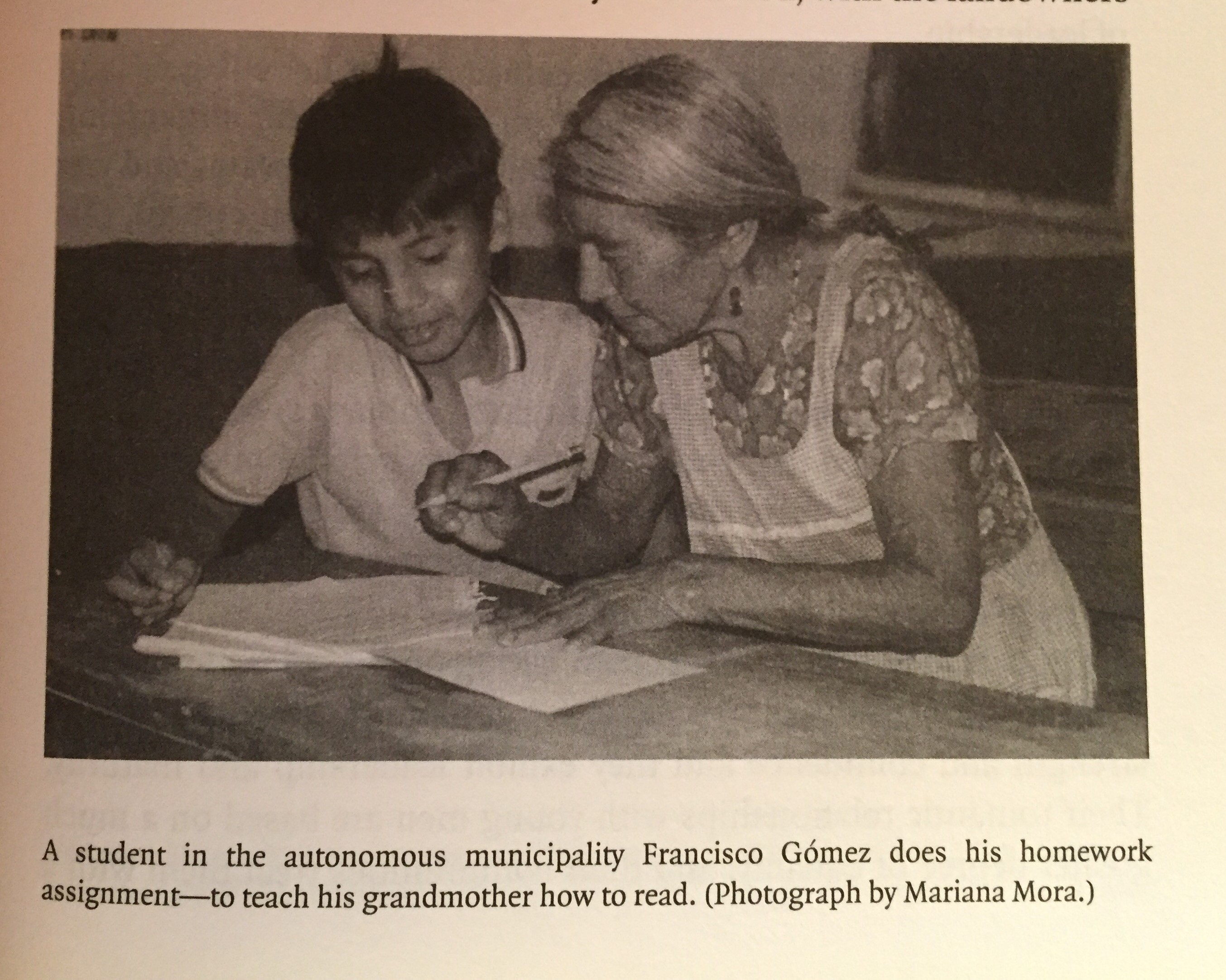
If our thinking were to remain within the frame of this photo, we might see this simply as a touching example of progress through education. We might imagine the child’s pride in teaching his grandmother a new skill and her thankfulness for gaining literacy after all these years. Yet I would urge us to zoom out from the frame and ask certain questions: What sort of struggle did it take to get here? How many generations of resistance and how much sacrifice did it entail? What were all the overlapping, violent, terrorizing structures that kept women from learning to read for hundreds of years? And what was this grandmother’s participation in the struggle for freedom from this oppression? We know the Zapatistas coordinated an uprising, so did she prepare food for the soldiers, lose a daughter or husband in the fighting, hide arms, or get displaced from her home? Did she recruit her family members to the organization? And if she lives today on land reclaimed in 1994, does she work on a communal plot to support the teacher who taught her grandson to read? Or does she work in a weaving cooperative that shares its proceeds? Maybe the biggest question of all is this: what does it take for a generation of indentured serfs to produce a generation capable of teaching them to read? This is the true extent of social movement. It is this understanding of social movements, as interventions into social relations, that I will explore in this essay. Beyond raising awareness, changing policy, or altering who administers government, “social movement as social intervention” means people coming together to destroy the very relationships that confine one generation to illiteracy and to forge the relationships that allow another generation to build freedom.
Can we conceive of social movement in this way, as a collective struggle to build relations of freedom? How would such a conception relate to other prominent ways of conceiving social movements? Moreover, how would it relate to Marxist conceptions of social movements, given that the Marxist tradition centres the concept of social relations more than other fields? I will take up these questions here, beginning with a historical survey of social movements that emphasizes their struggles to make certain interventions into social relations, to break with inertia and re-structure the way people’s needs are met so that these arrangements better favour those on the bottom. Next, I will move my survey to social movement theories, considering how each of the most popular theoretical traditions relates to this history of interventions into social relations. In the following section I elaborate a more nuanced conception of social relations, using this to argue that social movements are class struggle. I make this argument by first defining social relations as “ways of doing society” and as material relations that are spatial and concern value. I then define “class” as the process of forming a group powerful enough to assert certain social relations against others. This requires self-awareness (“class consciousness”), and it is always carried out against other classes asserting other social relations. This leads to my assertion that social movements are class struggle, a conflict between the many on the bottom and the few on the top over which relations will be dominant in society. Finally, I conclude with the ethical prerogatives presented by such a conception: that our theoretical work be strategic and committed to organizing practices for building power.
A movement history of interventions into social relations
“Social relations” are the ways we both collaborate and coerce each other, using our human capacities to meet our diverse needs. I will take up the concept in greater detail in the third section, but for now examples of social relations are the relationships of employees to each other and to their bosses, of a generation of youth to a generation of adults, of bureaucrats to their “clients,” or between property owners, renters, those in public housing, the under-housed, and police in a given neighbourhood. Each involves people “doing society” in a certain way, according to all the gendered, racialized, violent, and collaborative historical complexity that is bound up in any location. “Interventions” are therefore attempts “to change or maintain the structures that organise human activity …. mean[ing]that we see social structures and social formations as the sediment of movement struggles, and as a kind of truce line continually probed for weaknesses and repudiated as soon as this seems worthwhile – by social movements from above and social movements from below” (Nilsen & Cox, 2014, p.66). Indeed, the ways workers, youth, city-dwellers, and the precariously-housed relate to those with more power have all profoundly changed due to interventions by social movements. In doing so, “Every social movement derives from those who break with social inertia and begin to move themselves, which is to say, they change place, rejecting the place that they were historically allocated within a given social organization and seeking to broaden their spaces of expression” (Porto Gonçalves, 2001, p.81, my emphasis).
Social movements were making such interventions long before representative democracy, the advent of political parties, or even “social movements” becoming a recognized concept. Looking at local conflicts over the sale of bread, Thompson (1971) considers so-called “riots” in 18th century England. Reacting to encroaching free trade practices that increased both bread prices and profits for merchants, people asserted “a popular consensus as to what were legitimate and what were illegitimate practices in marketing, milling, baking, etc. This in turn was grounded upon a consistent traditional view of social norms and obligations … which, taken together, can be said to constitute the moral economy of the poor” (Thompson, 1971, p.79). Mobilization occurred at the marketplace, which was a “nexus” of conflict in that this space brought together large numbers of people with a “highly-sensitive consumer consciousness” that was increasingly under attack by the commercial practices exemplified by the Corn Laws (ibid). Successful actions, usually convoked by women, involved seizing stores of grain and bringing them to market to prevent hoarding and inordinate profit, thereby defending the social economy of the local marketplace. These instances were dissimilar to modern-day social movements in that they lacked identifiable leaders and made no formal demands on decision-makers, much less advocate for particular legislation and policy. In this way, the bread riots exemplify a central aspect of subsequent social movements throughout history: they were an assertion of “the moral economy of the poor” – collective interventions to keep economic relations embedded within broadly-supported social relations.
Polanyi develops the concept of embeddedness to explain how, during the great majority of human history (and still, to some extent or another in many places) there was no economic system independent of and with control over social status (2001, ch.4). “Economics” was a function of social organization, and reciprocity and redistribution coordinated production and distribution. This should by no means imply such interactions were all consensual, as there was a great deal of coercion and unequal distribution. Undoubtedly there were collective efforts by people disfavoured by sexist or xenophobic customs to modify redistributive practices. Yet inequalities in reciprocity and redistribution could always be attributed to specific people and specific social practices, instead of being a result of “the way the market works.” Establishing such a market and replacing reciprocity and redistribution with supply and demand and endless accumulation required a great disembedding of economic relations from relations governed by social norms. Most importantly, this was accomplished through a bloody history of making land, labour, and money into goods not subject to social regulation but instead only available on the market. This meant making “human society [into] an accessory of the economic system” (Polanyi, 2001, p.79).
Thompson’s “bread riots” were therefore social movements defending the moral economy of the poor. Like other social movements, they made specific demands on social relations, were mobilized in specific ways (here, in the physical marketplace, through conflicts over bread sales), utilized certain tactics (the direct action of grain seizure), and their effects can be measured by the endurance of social custom in the face of encroaching free trade practices. This defensive battle was ultimately a losing one, and as the market was forged through enclosure politics were also disembedded from social relations. (1)
Tilly develops the concept of “parliamentarization” (1997) to describe the transition during the 19th century from these types of “moral economy” movements to the state-oriented movements that are the primary focus of much of today’s social movement theory. Parliamentarization is the rise in “public, joint expression by word and deed of desires that concrete other parties act in certain ways, ways that would affect their interests” (ibid, p.248). “Parliamentarization” therefore represents a shift in the ways social movements mobilized, increasingly via formalized organizations with identified (nearly always male) leaders and directed towards the national political bodies built through the bourgeois revolutions. “Collective acts of retaliation, resistance, and direct physical control lost much of their prominence [while] …. Nonviolent, indirect, annunciatory, and preplanned actions waxed” (ibid, p.255). There was also a shift in demands, tactics, and measurement. Instead of direct action in defence of a general moral economy, parliamentarized movements increasingly made single-issue demands which “pivoted on rights and justice” (ibid, p.248), requiring “an enormous expansion and forward movement of contenders’ time-horizons” (ibid, p.264) for achieving the legislative changes by which we can measure these movements’ interventions. All this represents a significant disembedding of the way social movements went about making their interventions, as questions of the just distribution of resources became less enmeshed in social relationships and more of a “political” matter to be resolved by government.
“Labour” comprises the next set of social movements and interventions I would like to take up. The Industrial Revolution accelerated the causes Tilly cites for parliamentarization: “First, the rising scale and cost of war …. Second, increased capitalization of industry and agriculture” (1997, pp.250-251). The growing power of capital caused a sea-change in social relations, and the fight to establish unions was one way social movements intervened to resist this violence. Increasingly during the latter half of the 19th century workers took collective action in response to their own daily experiences of exploitation and were further armed with Marx’s critique of capitalism: its systematic drive increase accumulation by forcing down wages, extending the working day, making work a lethal endeavour through negligence (increasing absolute surplus value extraction); by introducing more machinery to increase the pace and intensity of work (relative surplus value extraction); culminating in periodic crises that throw workers into misery because they had produced so much while earning so little that markets collapsed (capitalism’s ‘first contradiction’ (Harvey, 2014, pp.62-69)). However, industrialization also brought ever-larger numbers of workers together under one roof, and social movement participants braved blacklisting and assassination to successfully form mutual-aid societies and labour unions across the industrialized world. Unions intervened to put a check on the violence of the disembedded capitalist economy, winning some measure of social regulation allowing for reciprocity and redistribution.
The basic tactics for achieving this were organizing unions, and “Their power is of course the disruptive power of the strike” (Piven & Cloward, 1979, p.79). McAlevey traces a genealogy of the tactics that successfully built enough solidarity for strikes to be possible back to leftists working within the Congress of Industrial Organizations. Their craft involved “identifying organic worker leaders in the shop and anchoring campaigns in the ‘whole worker,’ understood to be a person embedded in a range of social relationships in the workplace and in the community” (2016, p.19). Organizing workers and striking were used to pursue a variety of demands, including the eight-hour workday and later resistance to Fordism’s “introduction of the self-moving assembly line [, meaning] the worker not only performed repetitive operations but also lost control over the pace of work” (Aronowitz, 2003, p.67). Yet the biggest demand was higher wages, especially during the North American labour insurgency of the Great Depression. Piven and Cloward write that “The overall drop in wages, together with unemployment and the spread of part-time employment, meant that the income of the labor force had been cut in half, from $51 billion in 1929 to $26 billion in 1933” (1979, p.108). Such cuts galvanized the period’s first wildcat strikes, and thereafter the social movement’s level of mobilization can be measured by both quantitatively tracking unionization numbers and strike actions, as well as qualitatively measuring workers’ “capacity to disrupt the economy” (ibid, p.96).
The goal of all this mobilizing was to fundamentally alter the social relation known as “work” by establishing the foundations (union membership) upon which workers could lessen their exploitation by winning higher wages, a more manageable pace, and the collective dignity of negotiating with the boss as equals. Having won the legal right to unionize during the Great Depression, the North American and European labour movements increasingly sought take make social interventions by pursuing what Wallerstein (2004) calls a “two-step strategy” of first gaining control of the state to then wield it as a tool against exploitation by capital. By the early 20th century the German labour movement was successful in using the reformist variant of this strategy, gaining considerable representation in government, while the Russian Revolution best exemplifies the revolutionary road to state power. Looking back to the process of “parliamentarization,” government was no longer just the venue where social movement demands would either be implemented or ignored, but a tool movements could use to directly implement them. While this success brought improvements in education, healthcare, housing, wages, working conditions, and overall stability to millions of people during the 20th century, it also exposed the limitations of state-oriented social movement strategy. Socialist parties in the liberal democracies collaborated with capitalists instead of opposing them, infamously sending workers to slaughter other workers in the two World Wars. They increasingly practiced “business unionism”: “sign[ing] clauses that limited workers’ right to strike at the expiration of the contract …. To compensate for surrendering the right to strike the typical contract contains a procedure for resolving grievances whose final step is arbitration if the parties cannot agree. Reliance on mediation and arbitration is consonant with the belief in a mutual labor and management interest to maintain class peace” (Aronowitz, 2003, pp.87-88). Moreover, instead of looking outside the factory towards workers’ broader social networks to organize workers as broadly as possible, across barriers of race, the skilled and unskilled trades, and engaging the employed and unemployed (McAlevey, 2016, ch.2), business unionism meant promising to deliver a labour force to the boss in exchange for better wages and contracts and supporting the Fordist model of disciplining workers through mortgage debt and micro-managing their workflows (Aronowitz, 2003, ch.3). The same trend of socialist organizations serving to discipline workers occurred under communist governments. They nationalized businesses, but workers continued to be squeezed by Taylorist speed-ups at the assembly line and increased quotas, the main difference being their bosses were now bureaucrats instead of capitalists (Dunayevskaya, 1975, ch.8).
Nonetheless, labour movements achieved impressive interventions into social relations. Piven and Cloward write that “Clearly, the straightforward concessions in higher pay and shorter hours and in government social welfare measures offered up at the height of the turmoil of the 1930s were worth winning … Wages have kept pace with rising productivity and profits [and] workers are now protected against reprisals in union-led strikes” (1979, p.174). More broadly, movements established unionized, waged labour as the male workers’ ticket for achieving full citizenship for himself and his family, (2) including the rights to social services and collective civic engagement (Zibechi, 2012, ch.6). These gains were not limited to the First World, or even the “state capitalism” of the Second World, but also across Latin America with strong labour movements and expanded social services in Mexico, Brazil, and the Southern Cone. This was indeed a sort re-embedding, as workers’ political power won a greater degree of state regulation over the market. Some would even argue that labour had done more than demand greater regulation – the movement had become part of the bloc of powerful actors who would carry it out (Aronowitz, 2003, pp.76-91). Not only did the labour movement fundamentally alter the social relations by which work is done, they also altered the terrain of class across society, including the social relations through which we “do” housing, politics, and education. Yet the next phase of social movements, commonly associated with 1968, would highlight all the ways these interventions still fell short of establishing egalitarian social relations.
Whereas the labour movement’s successful demands for the right to unionize, higher wages, and social welfare altered the “First World” political landscape, for the so-called new social movements “the gap between democratic promise and authoritarian political reality … turned many young people into skeptics, if not outright opponents, of the economic and political systems” (Aronowitz, 2003, p.148). Participants recognized that “What a rationalized capital – equal pay, more and better nurseries, more and better jobs, etc. – can’t fix, they call ‘oppression’” (James, 1972, pp.2-3) and that the institutionalized wing of the labour movement had been silent on such issues. Liberation movements in the formerly-colonized countries found themselves in a similar situation. They succeeded in reclaiming land and government from the colonizers, only to find their national institutions remained just as oppressive under the management of the new national bourgeoisie (Fanon, 1963). Anti-imperialists called attention to how producing arms for these bloody independence conflicts was used to bolster industry in the First World. In North America, Blacks and indigenous peoples proclaimed that, instead of being “included” in capitalist development, this development was based on their subjugation and dispossession. The feminist movement asserted that women were also excluded and forced to do the unwaged labour of reproducing the workforce (Dalla Costa & James, 1975).
The common thread is that, by and large, the labour movement was not an ally to anti-colonial, anti-imperial, Black liberation, indigenous sovereignty, or feminist movements (Aronowitz, 2003, pp.156-162). A great deal of social movements literature analyzes and problematizes this rift (De Sousa Santos, 2003; Polletta, 2002; Wallerstein, 2004), but in terms of “interventions” we see the social relations which movements seek to change are much more than just those of waged production. Capitalism makes production more exploitative, but it also affects questions of who gets the unionized work building bombs and who these bombs are dropped on, who is forced to dedicate their life to the unpaid work of cleaning and nurturing present and future wage earners, who is relegated to being a permanent underclass because of their race, and who is forced onto reservations while these processes play out on their land. While they did not end colonialism, white supremacy, or patriarchy, these movements surely checked their unrestrained violence in the same way unions had with capital. Huge swaths of Africa and Asia gained political independence, Blacks in the US ended terrorism and lynching carried out with impunity and protected by disenfranchisement, and women rolled back their sexist exclusion from controlling their finances or their bodies.
While the new social movements are commonly defined in opposition to the labour movement, this can lead us to overlook the many ways that labour struggles intersected with gendered, racial, and independence struggles while leaving us without a positive definition of the new social movements. (3) Finding shared characteristics is difficult, as Third World independence movements and First World anti-oppressive movements occurred in quite different political, economic, and cultural contexts. Take participatory democracy, which was a defining tool of many First World new social movements, for example. “Sustaining a decentralized, nonhierarchical, and consensus-based organization seems to mean sacrificing the quick decisions and clear lines of command necessary to winning concessions in a hostile political environment” (Polletta, 2002, p.1), making it less than ideal for the armed uprisings of Third World liberation movements. Yet there were also common mobilizing structures across the two contexts, including communist parties unaffiliated with the Soviet bloc (Castells, 1983, pp.109-209), places of worship espousing liberation theologies (hooks, 2000, pp.121-3), and within the “marginal” neighbourhoods (Castells, 1983, pp.185-190) that grew throughout the First and Third Worlds as the recession of the early 1970s set in. New social movements also shared common limitations, including the tendency for the poorest women, Blacks, and members of newly-independent nations to see the least gains from the movements. Aronowitz refers to the First World when he writes that “joblessness among women remains higher than that of men [and] …. in some ways the black working class as a whole is worse off than it was in 1970” (2003, p.169). hooks writes that “Well-off black folks attempt to create a social context where they will be exempt from racist assault even as the underprivileged remain daily victimized” (2000, p.95). Fanon explains the reasons for a similar continued impoverishment following independence, writing that “[The national middle class’s] mission has nothing to do with transforming the nation; it consists, prosaically, of being the transmission line between the nation and a capitalism, rampant though camouflaged, which today puts on the task of neo-colonialism” (1963, p.152).
Taken together, new social movements’ general interventions into social relations were to promote freedom against oppression, as manifest in struggles against political authoritarianism, colonialism, gendered oppression and exploitation, and white supremacy. Because their demands for freedom were greater than simply political independence, an end to lynching, and closing the gendered wage gap, it is quite difficult to measure the success of these interventions into social relations. Yet their effects can be seen in elites’ neoliberal offensive to roll back their gains. Financialization and trade liberalization gave capital the added mobility needed to outflank immobile labour, plus the use of debt to discipline the working class, especially by forcing the privatization of social services. This allowed elites to finally succeed in disciplining the unruly masses beginning in Latin America, where dictatorship, the forced disappearance of tens of thousands of activists, and international debt were used to destroy the nationalist, pro-labour import substitution model (Webber, 2011, pp.30-33). In Europe and North America, free trade agreements paired with increasingly militarized borders gave capital the mobility needed to offshore production to places where workers could be more heavily exploited while limiting the ability of these same workers to emigrate and find higher paying jobs elsewhere. Most importantly, capital was not just strengthened relative to labour and other oppressed groups, but also relative to the state. Its ability to cross international borders in search of a better “business climate” led governments to pander to capital’s demands for less taxes and regulation, thereby rendering the national “parliamentary” level an increasingly inadequate option for the resolution of social movement demands.
Opposition to neoliberalism began to congeal during the mid 1990s through the “movement of movements,” including both large labour unions and small collectives, both in the Global North and Global South (to use the post-Cold War geopolitical parlance), opposing labour exploitation as well as “other” forms of oppression related to gender, race, ability, sexuality, and ecology (Mertes, 2004; Shepard & Hayduk, 2002; Wood, 2005, 2012). Similarly to the new social movements, these groups are united by a shared opposition to neoliberalism (Graeber, 2004, p.203). Positively, many had shared roots in “the affinity-group model used by American anti-nuclear activists, using the anarchist, pacifist, and civil rights tradition of localized decision-making; the direct action techniques of pacifists who physically confronted systems of power through ‘misuse’ of spaces; and the feminist emphasis on process” (Wood & Moore, 2002, p.28) This led participants to be deeply committed to combatting vanguardist authoritarianism by equating means and ends. This foundational principle was manifest in the celebratory nature of their organizing, by “forg[ing] a novel style of street protest that departs from the tired old-style street pickets and rallies of days past” (Shepard & Hayduk, 2002, p.199). This “period of tactical innovation” popularized the use of “black blocks, jail solidarity, blockades, and giant puppets” as well as “Reclaim the Streets parties, Radical Cheerleaders, the strategy of targeting corporations, and the adoption of organizational forms like the affinity group and the spokescouncil” (Wood, 2012, p.5). Internally, the participatory democracy techniques developed by new social movements over the preceding generations became quite developed and widespread, showing that “models for egalitarian forms and deliberative styles are simply available to activists today in a way that they were not for 1960s activists” (Polletta, 2002, p.191). By organizing both an effective resistance to neoliberalism and utilizing participatory democracy to do it, “a uniting agenda is that of challenging rule by politicians [and showing that] we can govern ourselves” (Sitrin & Azzellini, 2014, p.10).
Aided by international convergences convoked by the Zapatistas and at the World Social Forum, this wave of social movements succeeded in shutting down World Trade Organization negotiations in Seattle and in sinking the proposed Free Trade Area of the Americas. On the heels of these victories, activists were confident that they were on their way to “building a global movement to overthrow corporate control and create a new economy based on fairness and justice” (Starhawk, 2002, p.56). Yet the movement also faced difficulties, including a consensus process that “often prove[s] off-putting or prohibitive to working-class organizers,” “a simplistic hostility toward ‘leaders’ and ‘leadership,’” and “inability to become multiracial organizations” (Cornell, 2011, pp.174, 175, 178). Internationally, there remained a chasm between organizations from the Global North and Global South, as small, short-lived, flexible collectives sought to coordinate with larger, longer-term, more formalized mass movements from the south (Wood, 2005, p.105). Ultimately, despite all their breakthroughs in the use of novel tactics, participatory democracy, and international collaboration, criminalization of dissent following the September 11th attacks marked the decline of the “movement of movements” (Wood, 2012, ch.11), and despite the largest day of concurrent protests in world history on February 15, 2003 they failed to stop the US military from invading Iraq (White, 2016, p.28). Eight years later, the Occupy movement was a massive repudiation of the power of finance over politics and society as a whole, involving a greater level of sustained direct action than the US had seen in decades, yet it also failed to progress on its demand to get money out of politics. As with new social movements, this makes the success of the movement of movements’ interventions into social relations difficult to measure. We can look to activity in the World Trade Organization and International Monetary Fund, their (in)ability to impose structural adjustment programs around the world, and heads of state who were removed by popular uprisings against austerity across the Global South. Yet, in steadfastly equating ends and means, the movement of movements also sought to build more egalitarian, democratic, non-capitalist social relations within their groups and in society at large. They surely benefited from the cache of principles and techniques inherited from the new social movements in moving this mission forward, yet empirical measurement of this progress remains elusive.
Just as with the 18th century bread riots described by Thompson, today’s movements demand that consensual, ethical, and social concerns shape how we “do society” rather than the dictates of the market. In the interim, parliamentary movements sought to access the spaces of representative democracy to win rights and policies that would influence social relations; the labour movement used the strike to change the nature of “work” and advance welfare as a fundamental social organizing principle; and the new social movements intervened to curtail oppressive social relations beyond workplace exploitation. Each mobilized through different spaces and organizing forms (popular marketplaces, political parties, unions, community spaces, and affinity groups), utilizing different tactics (seizure of resources, campaigns, strikes, non-violent direct action, and celebratory tactics). Yet measuring the success and failures of each remains elusive, especially with recent anti-systemic movements. Furthermore, narrow questions of each movements’ demands and tactics fail to shed light on the question with which I began this essay – how a generation of serfs can raise a generation capable of teaching them to read. Instead of making precise, quantifiable demands of the labour movement or the broad call an end to oppression and corporate dominance we saw with new social movements and the movement of movements, this sort of inter-generational change is both concrete and wide-ranging. The seizure of property, strikes, and participatory democracy are too narrow to explain how such a transformation might be achieved. It is a profound modification of social relations, without being so sweeping as to be utopian. It involves a level of mobilization much greater than the formation of a party, union, or affinity group. Because the question demands further explanation, I turn from social movement history to theory, looking to the various schools of thought that seek to explain how and why movements mobilize and demobilize, how to explain their successes and failure, and – most importantly – what strategic tools future movements can use in their quest to make interventions to change social relations to the degree the teacher-grandchild exemplifies.
Social movement theories, between interpreting the world and changing it
Over the past hundred years the analysis of social movements has gone from being the purview of small cadres of criminalized radicals to a theoretical tradition firmly established within the academy. Along the way each school of thought has asked different questions of social movements, developed different conceptual tools to explain their mobilization, demobilization, success, and failure, and constructed different strategic recommendations for how movements can best intervene in shaping social relations. Along these lines, I will briefly survey the Marxist, Resource Mobilization, Political Process, New Social Movement, and Movement-Relevant variants of social movement theory, bearing in mind that each is quite rich, full of debate, and much more varied than the few thoughts included here. Rather than adding to all the other literature that compares, contrasts, and critiques these traditions (Aronowitz, 2003, pp.156-162; Bevington & Dixon, 2005, pp.185-189; Castells, 1983, pp.291-301; Choudry, 2015, pp.41-80; Escobar, 2008, pp.21-24; Krinsky, 2014, pp.105-108; Webber, 2011, pp.3-11), I consider them so I may highlight how the concept of “social movement as class struggle” is both beholden to them and seeks to build upon them.
Just as there was a time before people engaging in collective political action would identify as a “social movement,” there was also a time before it was the object of a corpus of academic theory. Indeed most early “social movement theorists” were anticapitalist political organizers looking to better understand their context of struggle and strategies for success. Reflection by committed activists on the struggles of the day led Marx and Engels to write their manifesto to support organizing by the nascent Communist Party (2017), Rosa Luxemburg to urge her comrades to fight for revolution instead of reform (2008), Lenin to advocate the formation of vanguards (1989), Gramsci to consider how Italian fascism had succeeded in defeating leftist movements (2011), Dunayevskaya to ask how the hope of the Russian Revolution had turned into a Stalinist nightmare (1975), and Fanon to decry the post-independence obstacles confronting decolonial struggles (1963). Marxist social movement analysis seeks to map political-economic power across society, beginning with its most general components: “Crudely but clearly stated, those who control the means of physical coercion, and those who control the means of producing wealth, have power over those who do not” (Piven & Cloward, 1979, p.1). It is also important to look towards the bottom of the social hierarchy and map out disempowerment, especially:
“First, [how] people experience deprivation and oppression within a concrete setting … and it is the concrete experience that molds their discontent into specific grievances against specific targets …. Second, institutional patterns shape mass movements by shaping the collectivity out of which protest can arise … Third, and most important, institutional roles determine the strategic opportunities for defiance, for it is typically by rebelling against the rules and authorities associated with their everyday activities that people protest.” (ibid, pp.20-21)
Together, power relations seen from above and below help theorists understand society’s class structure. This outlook is apt for theorizing social change, as it centres conflict over social relations. How do dominant groups who would like to benefit ever more from the exploitation and dispossession of marginal groups manage to maintain control and how are those on the bottom constantly resisting? Concepts such as the relations of ruling (Smith, 1987) and hegemony (Sassoon, 1980. pp.109-119) help us understand how such a volatile situation is haphazardly maintained. (4)
Yet Marxist social movement theorists also risk focusing too much on the structural level, falling into “a mechanistic or economistic problematic which robs the party, or the subjective factor, of any concrete possibility to intervene in history” (Sassoon, 1980, p.202). We need a more fine-grained analysis if social movement theory is to inform strategic practice for social change. This leads theorists to investigate the specific obstacles that maintain domination and to ask what concrete processes of social change might look like. One set of obstacles are the subjective, “an antagonism between individual deed and social consequences …. between momentary interest and ultimate goal” (Lukács, 1971, p.73). For example, members of the Frankfurt School considered the so-called middle class and the “link between their intermediate, relatively powerless economic standing and their receptivity to right-wing appeals” (Aronowitz, 2003, p.70) and concluded that
Chances for class formation and class politics could not be confined to the conventional Marxist formula that revolution is possible in the conjunction of inevitable capitalist crisis, the degree of working class organization, and the efficacy of strategies and tactics of mobilization. [They] insisted on the salience of the so-called private sphere of the family, of the cultural sphere, and of the new role of the state as an ideological as well as a political force. (ibid, p.72)
To overcome this multi-faceted domination, first it is necessary that those oppressed develop an explicit understanding of their oppression. As Bannerji writes, “it appears that whole groups of people suffering from denials, erasures, dis- or misidentification, evince a passion for naming themselves” (1995, p.21). Establishing such names is itself a struggle against the powerful, and it provides the basis for a “local rationality,” “the ways of being, doing and thinking that people develop as attempts to oppose the everyday routines and received wisdoms that define the hegemonic elements of common sense” (Nilsen & Cox, 2014, p.74). As this process develops further, local rationalities “can lead to direct confrontations with and defiance of social movements from above” and, “through connections with other activists engaged in similar struggles elsewhere,” cohere into “a generalised challenge to the dominant forces” (ibid, p.75, 76, 77). The impact of such social movement processes can be measured by “the disruptive effects on institutions of different forms of mass defiance, and … the political reverberations of those disruptions” (Piven & Cloward, 1979, p.24). Pursuant of these goals, theorists have proposed that organizers develop organic intellectuals who can “perform organisational and connective functions” (Sassoon, 1980, p.134) and the broader creation of a party as a “mechanism both for the elaboration of its own organic intellectuals prepared in the ideological and political fields, and it is the mechanism of the establishment of hegemony” (ibid, p.148). Ultimately, they theorize that this strategic movement building work is done “to overturn or otherwise modify existing power relations” (Aronowitz, 2003) to such an extent that social relations of exploitation, dispossession, discrimination, and repression no longer shape society. These are useful concepts for thinking about how a generation of serfs might raise a generation capable of teaching them to read, and I will come back to them in the next section as I take up that question in greater detail.
Centered in the US, Resource Mobilization theory grew during a time when identifying as a Marxist meant sacrificing your career. Therefore, their distance from Marxism allowed Resource Mobilization theorists to become the first to write positively about social movements from within the academy. As Gamson describes (1975, pp.130-136), this was an attempt to counter-act the mainstream theories of social movements: the two-sided coin of pluralism and deviance theories. Pluralism posits a rational democracy that prohibits elite domination, is responsive to citizen initiatives, and produces orderly change without violence (1975, ch.1). Assuming such a system, extra-parliamentary political movements are unnecessary, which is where deviance theory steps in, considering them to be outlets for alienated individuals looking for hope, myth, and a messiah. Resource Mobilization, on the other hand, sought to carve out a space in academia and mainstream discourse for thinking of extra-parliamentary collective action as a rational and just endeavour. Furthermore, these thinkers sought to understand how exactly outsiders gain access to the formal political system (ibid, p.141). Against pluralism, Gamson’s sweeping study of 53 social movement organizations over 145 years showed the US electoral political system was actually quite hostile to initiatives by political outsiders. Despite how closed the democratic system was shown to be, Resource Management theorists found that these outsider social movements behaved quite rationally in seeking that government meet their demands: “Group conflict in its dynamic aspects can be conceptualized from the point of view of resource management. Mobilization refers to the process by which a discontented group assembles and invests resources for the pursuit of group goals” (Oberschall, 1973, p.28). Understood in this way, the social movement research agenda is quite clear:
“First, study of the aggregation of resources (money and labor) is crucial to an understanding of social movement activity …. Second, resource aggregation requires some minimal form of organization …. Third … there is an explicit recognition of the crucial importance of involvement on the part of individuals and organizations from outside the collectivity which a social movement represents. Fourth, an explicit, if crude, supply and demand model is sometimes applied to the flow of resources toward and away from specific social movements. Finally, there is a sensitivity to the importance of costs and rewards in explaining individual and organizational involvement in social movement activity.: (McCarthy & Zald, 1977, p.1216)
A movement’s success or failure in building organization to capture and mobilize resources can ultimately be measured by how government receives their demands, either giving a “full response,” “pre-empting” the group by implementing the demands without recognizing those who made them, “co-opting” the group to avoid implementing their demands, or reactively (and often violently) causing the group’s collapse (Gamson, 1975, pp.28-37). While such a framework aids in understanding the “parliamentarized” social movements Tilly writes about (1997), as well as new social movements groups advocating for national independence, gender and racial equality, and civil rights, there are problems explaining the other historical movements mentioned above. The 18th century bread riots had no formal organization or demands on the political system; Piven and Cloward persuasively argue that the labour movement made its greatest advances before it gained formal union representation (1979, ch.3); many new social movements demanded fundamental changes to political culture instead of gaining acceptance into the political system; and the affinity groups and collectives typical of the movement of movements’ Global North largely operated without significant monetary resources or the sort of organizational structures suggested by Resource Mobilization theory. Most importantly, questions of inter-generational liberation and literacy surely are contingent on more than the organizational capacity to build a school, having to do instead with the power needed to overcome the forces that impose illiteracy as to maintain exploitation and dispossession.
As it further developed and gained more historical, conceptual, and explanatory complexity Resource Mobilization morphed into Political Process Theory. Distancing themselves from Resource Mobilization’s corporate language of economic rationality, theorists also adopting a broader understanding of “politics” than the laws and policies on the government’s agenda, asking what “process[es] shaped governments throughout the western world” and created “path[s] to democratic government” (Tilly, 1997, p.246). This tradition therefore places a great emphasis on the way political arrangements, cultures of political contention, and their disposition towards violence shape what is possible for social movements to achieve. These structuring regimes “impose limits on collective claim making” and “constrain or facilitate particular patterns of communication claimants that pool information, beliefs, and practices concerning what forms of claim making work or don’t work” (Tilly, 2008 in Wood, 2012, p.49). Understanding structure in this way lends a greater appreciation for culture in social movements, such as how new structural conditions lead to new identities among social movement actors (Tarrow, 2005, pp.41-42). On an even more specific level, Political Process Theorists have considered what characteristics make for strong organizations – including their strategic capacity and ability to innovate and incorporate new practices (Wood, 2012, p.15) – and how the formalization assumed by Resource Mobilization to be universally positive may in fact limit this capacity (Rogers, 1995). Finally, Political Process Theory (which integrates Marxist analysis to a greater extent than Resource Mobilization) zooms out from case studies of social movements to re-consider how their agency has interacted with larger structures. For example, Piven and Cloward conclude their study of movements of the unemployed, workers, and for civil rights by famously stating that “protestors win, if they win at all, what historical circumstances have already made ready to be conceded” (1979, p.36). This tradition therefore joins Marxism in developing a rich interplay of structure and agency that aids in understanding how longer-term transformations in the structures that shape politics might be achieved.
New Social Movements theory developed in response to the same Marxist “mechanistic or economistic problematic which robs the party, or the subjective factor, of any concrete possibility to intervene in history” (Sassoon, 1980, p.202) that was noted earlier. Castells writes that:
“Marxism was ambiguous about the existing social movements: they were the living proof of class struggle and resistance to capitalist exploitation. And yet the movements had to accept … that they could not produce history on their own but, rather, were instrumental in the implementation of the next stage of a programmed historical development” (1983, p.299)
Many agreed that the “glorious ruins of the Marxist tradition” (Castells, 1983, p.301) were quite determinist and did not consider Resource Mobilization or Political Process Theory to remedy the issue. Deserved or not, this critique led New Social Movements theorists to integrate a number of new categories and concepts into their analysis, as to problematize the many factors involved in social structuration and allow for a richer understanding of agency. For example, in his survey of urban social movements over various centuries Castells asks “How do class, sex, race, ethnic origins, cultural tradition, and geographical location, contribute to the formation of the social actors that intervene in the urban scene?” (ibid, p.xvii). Castells also complements Marxism’s traditional focus on production with an eye to social movement demands for collective consumption. Another way Marxist and Political Process notions of structure are made more complex is through the differentiation of space and place, contrasting “Place-based struggles [which] more generally link body, environment, culture, and economy in all of their diversity” to the space-based forces of capital, science, and development, which are assumed to unilaterally refashion places according to their dictates (Escobar, 2008, p.7). Identity also becomes a major axis of social movement theorizing. For example, Escobar writes that “Identities are dialogic and relational; they arise from but cannot be reduced to the articulation of difference through encounters with others; they involve the drawing of boundaries, the selective incorporation of some elements, and the concomitant exclusion or marginalization of others” (2008, p.203). Identity construction comes to be recognized as a powerful motor of social movement mobilization, as does building “place” by engaging in collective consumption and self-management.
Finally, instead of participating in the inevitable communist revolution (too determinist), accessing the formal political system (too reformist), or navigating political structures in order to have demands met (too instrumentalist), New Social Movements theorists assert that groups engage in this process to change the fundamental social structures within which economic, political, and cultural change plays out. In his work on urban social movements, Castells writes that “The basic dimension in urban change is the conflictive debate between social classes and historical actors over the meaning of urban, the significance of spatial forms in the social structure, and the content, hierarchy, and destiny of cities in relationship to the entire social structure” (1983, p.302). This presents yet another take on how a generation of serfs might raise a generation capable of teaching them to read. Whereas Marxism would focus on how a movement would need to build a core of organic intellectuals capable of articulating a coalition to fundamentally alter the relations of ruling; Resource Mobilization would highlight the importance of capturing human and monetary resources within a competitive environment and developing sufficient organization to mobilize them; and Political Process Theory would focus on the interplay of evolving repertoires of action, diffused through inter- and intra-group communication, with political regimes; New Social Movement theory would assert that this change depends on the ability of the group to build a collective identity allowing it to engage in enough self-managed production and collective consumption to change the way exploitation and dispossession happen, allowing an opening for autonomous projects to further develop.
Movement-Relevant Theory is not developed enough to be considered an entire field of social movement theorizing, but it is important to end here as it seeks to augment the strategic value of the theories outlined above. Its practitioners advocate ‘getting back to basics’ and asking “In what way does the validation, elaboration, and refinement of concepts provide useable knowledge for those seeking social change?” (Flacks, 2004 in Bevington & Dixon, 2005, p.189). Cox and Nilsen begin by establishing emancipation as the goal of the “usable knowledge” Flacks references. They do this by situating themselves within the Marxist tradition of seeking to understand “organised human practice” (2014, p.6) in order to achieve historicity – the ability of the many to build social structures that develop our capacities and meet our needs, rather than having structures that scarcely meet our needs and under-develop our capacities imposed on us by the few (ibid, pp.39-41). Given the general pursuit of historicity, Movement-Relevant Theory asserts that theory’s role is to generalize the experience accumulated by groups engaged in this struggle for freedom (Bevington & Dixon, 2005, p.191), as part of a collective effort by thinker-practitioners to build wisdom and share it with others. Building strategic theory in this way requires sustained engagement in social movements so that we can theorize using the concepts and categories participants are using, (5) contribute to the internal debates they are having, (6) understand current obstacles, and build theory as a tool for finding solutions. This is part of a broader commitment to respecting the way people seek to name themselves, their dreams, and their actions instead of building knowledge/power by naming and categorizing people without their input (Bannerji, 1995, ch.1; Choudry, 2015, pp.47-51). This does not mean sacrificing criticism and simply following movements. Movement histories such as Cornell’s analysis of the Movement for a New Society (2011) and Katsiaficas’ history of Autonomen (2006) are quite critical of the groups’ shortcomings. Yet they make these critiques as comrades, prioritizing participants’ reflections and ideas for how they could have done better.
For these reasons Movement-Relevant Theory would add on to our guiding question, asking how we can learn about the struggle of a generation of serfs to raise a generation that can teach them literacy in such a way as to enrich other contemporary social movements happening elsewhere. Epistemologically, this means that the truth of theory will not be won or lost through rhetorical battles with other ideas, but to the extent that people can make it true in practice (Cox & Nilsen, 2014, p.1; Krinsky, 2014, pp.115-117; Lukács, 1971, pp.197-208). In all things social, truth is a question of power. For example, the truth of capital exists in its power to shape our social relations to favor the accumulation of value; the truth of community is in its persistence despite the forces of alienation; and the truth of socialism, autonomy, freedom, or any other alternative is an open question as long as they remain submerged. Therefore conceptual understandings of organizational structure, the mechanics of communication, persuasion, and political influence, or more expansive notions of oppression and authority are indeed useful, but only if they are applied to the pursuit of building power. Left alone, these concepts teach us what is wrong and what alternatives might look like, but they do not help us pursue them. To build the power to make such ideas true – to build the power necessary one generation to dispossess their dispossessors and establish the self-managed services with which the next generation will develop a historically unprecedented level of knowledge – we need large numbers of people, acting in unity while enriching our difference, engaging in a sustained effort to overcome the impositions of the few as to satisfy the needs and develop the capacities of the many. In short, for effective interventions into social relations we need class struggle. In what follows I will develop ideas on social movement as class struggle in the spirit of creating conceptual tools for this pursuit.
Social movement as class struggle
Perhaps it is best to begin with what I don’t mean by “class.” I do not aim to be like the person (nearly always a white man) who get on the mic during the Q&A of every social justice presentation and gives an unsolicited lecture on working class struggle. This is the image that immediately appears for many when they hear talk of class, summoning memories of acrimonious debates where Marxists denounce ”identity politics” for “ruining the Left.” What these angry Marxists are referring to is New Social Movements’ critique of a myopic focus on white, male, able-bodied, industrial, First or Second World waged workers. Many Marxists have been guilty of perpetuating this narrow conception, and I will endeavour to surpass the asinine debate that pits class, exploitation, and redistribution against identity, oppression, and recognition.
A less vociferous problem is the tendency to declare that certain groups of people automatically belong to one class or another by virtue of their job or income, without giving attention to how these people identify themselves, much less the collective actions they do or don’t engage in. This is the purely objective understanding of class that Aronowitz calls “class as space” (2003, ch.2), likening it to positions on a totem pole. Instead, I will define class first as a social relation. The particular social relation called “class” exists only when those who are part of it have the power to exert themselves against other classes who would prefer this new class not enter the social structure and that they not intervene to alter the functioning of this social structure. Social movements are the process by which classes are formed and by which they make their interventions. This means that, instead of an expert simply deciding which classes they believe to exist, that it takes a social movement to create “class” in the first place. Class must therefore be conscious of itself, (7) and “consciousness” is an ongoing effort inextricable from its struggle to exert itself within the social structure. Therefore class and social movement are class struggle.
Social relations are usually brought up by authors explaining dialectics, making for quite philosophical discussion. Ollman’s famous summary of the dialectical method describes social relations as the fundamental units of society, instead of individuals or material objects with independent, internal properties (2003, ch.2). Indeed, dialectics makes the ontological assertion that an individual is their relationships with others and an object is the way it crystallizes aspects of these relationships. Because these relationships connect individuals and objects with all of society, social relations are best understood at the level of society and not at the individual level. Moreover, people and objects are the transformation of these relationships in space and over time, so social relations must be understood historically and geographically as well. Compared to common sense, this is quite a major ontological shift as it considers relations over time and space to be the fundamental units of reality instead of people or objects.
All this is well and good, but it leaves us with little understanding of how to comprehend – much less engage – “social relations” on an everyday basis. Lukács is a bit more helpful, defining social relations negatively against reification (1971, pp.83-109). Reification means only seeing objects, without the social relations they are crystallizations of: seeing politics as “the state” instead of as a relationship between groups with different amounts of power and resources; or simply believing that purchasing a commodity will bring happiness. Reification is therefore the process by which social relations come to be objectified under capitalism. De-reifying a commodity would mean asking how this object represents a relationship between myself and all the people who collaborated to produce it, as well as the people who owned and sold it, and under what conditions this process happened. It might also involve asking why I believe an object can bring me happiness and what social relationships I actually get joy from. Finally, it would involve considering how society might look if there were a general appreciation for these social-relations-through-objects instead of generalized reification.
When we do overcome reification and consider social relations in everyday life, we usually consider it negatively, as the ways of relating to each other imposed on us against our will. Being a woman who is harassed by her boss, a worker whose schedule is always changing, a person of colour forced out of their neighbourhood, or a person whose disability, illness, or “madness” renders them “unproductive” are all social relations: the relationships that constitute gendered power dynamics, precarity, the financial relationships of gentrification, relations of production. They speak to the fact that social relations are “ways of ‘doing’ society” (Nilsen & Cox, 2014, p.65), the different modes, moods, inflections, and shapes of relationships between people. How we “do” work – especially to the extent this means doing sexism, precarity, commuting/displacement, or how we “do” it corporally or emotionally – these are questions of the shape and inflection of our social relations. Notably, improvements on issues such as workplace harassment, eviction, and accessibility were all won by groups that understood these as social relations and made sustained, collective efforts to intervene and alter them.
However, lest we fall into a purely individual understanding of social relations as synonymous with personal experiences of racism, sexism, class exploitation, et cetera, I should emphasize the difference between individual and social relations. The social relation that gets wrapped into (and oftentimes hidden by) the label of “gentrification” is much more than the story of a family whose furniture is tossed onto the front lawn. Multiply this experience by the hundreds or thousands of people moving out of the neighbourhood and – most importantly – consider what are the general labour relationships, relations with police and bureaucracy, relations with banks, and the social fabric of relations with other members of the community of these displaced people. Compare their relations with the work, civic, financial, and community relations of those moving into the neighbourhood. How do these differing sets of relations between the two broad groups represent different ways of “doing community” in that neighbourhood? How do they represent different groups of people, in loose coalition and in diffuse conflict, carrying out different projects for “doing society”? This, I would argue, is how we begin to think about social relations. Understanding things on such a broad social level is no doubt difficult, but the social relations of gentrification listed above are all knowable and measurable, meaning there is indeed an objective quality to them.
Here we arrive at an idea mentioned repeatedly above but only tenuously explained until now: A first pass at thinking of social movements as class struggle is to see them as “interventions” regarding social relations. While these interventions can just as easily be made in defense of dominant social relations (consider racist movements against the de-segregation of schools), most social movements literature focuses on movements in and against dominant relations. For example, Castells (1983, pp.311-318) analyzes how contemporary cities are being remade into specialized nodes within a competitive international division of labour, with movements leading defensive battles against “urban renewal” and bureaucratic management. That is to say, the way they “do” work is increasingly beholden to globalized circuits of capital and the way they “do” city living is less a question of neighbourhood cooperation and more of bureaucratic navigation. Yet Castells casts these urban movements in a defensive light, writing that they “address the real issues of our time, although neither on the scale nor the terms that are adequate to the task” (p.331). I would argue that we instead consider social movements in a positive, creative light, understanding them as “nurseries of new social relations,” breaking with inertia (Porto Gonçalves, 2001, p.81). Looking back over social movement history, new social relations and new ways of doing society are frequently also new organizational forms. Examples are how movements oriented towards parliament (Tilly, 1997) fostered the relations wrapped into the labels “political party” and “campaign.” The labour movement created the social relations of “labour union” and “mutual-aid society.” The feminist movement created the relations of “sisterhood” and “consciousness raising groups.” People sometimes joke about the alphabet soup of sexual and gender identities referenced by the queer movement, but this is a testament to the rich diversity of social relations it has empowered. Finally, the broad North-South coalitions against free trade agreements formed new social relations manifest in assemblages such as the World Social Forum or People’s Global Action (Wood, 2005). This is all to say that new social relations – interventions into ways of doing society – frequently crystallize as novel ways of organizing cooperation.
But again, lest “social relation” get pigeonholed as “types of organizations,” I should clarify that this misses the materiality of social relations, especially concerning value and space. First, social relations are relations of value. This is because value is a measure of how cooperation enriches our social relations (representing another objective aspect of the concept). Processes like “enclosure,” “dispossession,” and “proletarianization” are ways of doing society that highlight how capitalism forces the production of exchange value to become the primary thrust of our social relations, subverting our non-capitalist relations (forcing us to “live to work” instead of the reverse). Indeed, I would venture to say Marx’s life work was to elaborate a concept of value that explains just how and why capitalist social relations had subverted non-capitalist ones. Conversely, many social movements’ interventions defend and create non-capitalist relations of using, distributing, and sharing value. Labour unions ameliorate the worst aspects of relations of production geared towards exchange value; the feminist movement has fought back against the ways the reproductive relations of unwaged domestic labour and exploited immigrant labour are structured to reproduce labour-power (Dalla Costa & James, 1975), advocating for the collectivization of reproductive work (Davis, 1983); and Zibechi (2012, ch.15) describes how an Argentine baking cooperative that trades bread for solidarity in defending their squatted factory (a non-capitalist value exchange) produces non-capitalist social relations.
Second, social relations concretely shape the construction of our physical spaces, thereby causing them to reproduce these relations in the interactions that happen there. For example, mothers of disappeared women explain how the space of the sweatshop town (without public investment in streetlights or mass transportation, with value produced in maquilas that enforce starvation wages through coercive discipline) produces social relations of gendered violence (Wright, 2004); in the rebellious suburbs of El Alto, Bolivia social relations that promote the dispersion of power are crystallized in spaces such as the plaza, community assembly, and cooperative utility projects (Zibechi, 2010, ch.s 1, 4). Castells highlighted how urban movements react against the new social relations that constitute the reconfiguration of cities as nodes of global capitalism (1983, ch.31).
In sum, instead of seeing social relations as simply the “-isms,” as forms of organization, as ways of producing and sharing value, or just as spaces, we should understand them as ways of “doing society” that articulate forms of power, organizing forms, the movement of value, and the organization of space. Returning to our perennial question, the indigenous serfs of Chiapas had to build social relations of militancy, comradeship, and gender quality within their communities through the construction of a clandestine network of self-defence and mutual aid groups. These groups re-oriented value from agriculture, charity, and government subsidies towards their clandestine operations, integrated the activities of neighbouring communities and hidden jungle camps into their social circuits, and prepared for the uprising that would dramatically alter their social relations with their masters, who maintained social relations of exploitation and dispossession during the entire process. Nonetheless, after ten years of secret preparations, it would take an additional ten years after their uprising for non-capitalist projects such as the autonomous education program to take root.
Given this broad context of social relations, “class” is a way of talking about collective interventions into social relations. I recognize this is quite different from its common usage, which connotes those social relations concerned with organizational forms like the factory or business, the processes of commodity production and exchange, the spaces of work, and the relations by which waged workers are exploited. As mentioned earlier, this frequently collapses into the narrow vision of class Marxists are accused of perpetuating. Instead, I will argue for a much more expansive definition of class than simply as “workers and bosses.” Rather, class is an intervention made by a “unity of the diverse” (McNally, 2014, pp.421-423), an alliance of people and groups who would normally remain isolated (because a peculiar quality of capitalist social relations is the way their reifying influence isolates people from each other) but who come together to shape social relations in a particular way, against other classes who wish to shape them differently. The labour movement succeeded in forming class and shaping relations of production, but we shall see how those who promote interventions regarding whiteness and reproduction act as a “class” also. In Marxist parlance this means class is synonymous with “class-for-itself” – people conscious of their commonality who advocate for their own interests. (8) This notion of class is also synonymous with subjectivity: people making their environment more appropriate for themselves (Bookchin, 2007, pp.22-31) and creating a “we” capable of conceiving and achieving this.
Who exactly is this subjective “we”? Bannerji argues it must come together through a process of naming (1995, ch.1), of developing a collective understanding of who we are, our common stories of past struggle, and our shared project for the future. This process is always contested, as people on the bottom who are building subjectivity must wrestle with the dominant ideology: the names and ways of naming that lead us to identify with the powerful, their history, and their projects. For example, to what extent do young, latinx, university-educated undocumented immigrants identify as “dreamers,” as Chicanxs, or with a long history of people whose institutionalized illegality has been used to build the North American economy? To what extent do white collar workers identify as “middle class” versus “working class,” and would they consider the unwaged and unemployed to share this membership with them?
Such questions of identification are an important aspect of class/subjectivity/building a “we,” but the sine qua non of class is that those building its subjectivity engage in a project to shape social relations. What sort of social relations will determine inclusion and exclusion? Whose life is expendable and whose life matters? Who must be terrorized for the social system to go on functioning as it does? Who produces the value, how do they produce it, and who benefits from this labour by accumulating wealth and power? And crucially, who will organize themselves with enough power to exert their preferred social relations against the wishes of those promoting opposing sorts of relations? Understood in this way, class is friction of antagonistic interests and antagonistic social relations (Thompson, 1965, p.357). “Whiteness” is a good example of a class in this sense, as it brings together an otherwise disparate group ranging from the ultra-wealthy to the indigently poor, in a project to structure institutions, space, and value creation around the social relation of whiteness, blackness, and indigeneity. Against this project, the US Civil Rights movement was the successful constitution of a class that ended lynching and disenfranchisement as explicit tools for structuring social relations around whiteness. The same could be said about the labour movement being the formation of an alliance powerful enough to end the expendability of the worker through industrial accidents, contamination, and starvation wages; the women’s movement building an alliance powerful enough to eliminate rape culture as a structuring relation in society; or indigenous movements asserting relations of decolonization by forcing the Canadian government to adopt a legal framework of reconciliation. These struggles are always spatial and historical, meaning they are processes that remain incomplete and occurred in some places but not others. White supremacy, wage slavery, rape culture, and colonization are still a daily reality for many. Yet in each case they are also less prevalent than if these movements had not existed, meaning the fact of class formation is proven by their successful intervention in social relations, against the will of those who defend these relations. They have successfully altered the ways we “do” society.
If class means the successful constitution of an alliance to assert different social relations, what is the awareness that allows this? What is the connection between thinking and doing? What makes a class be for itself? How to understand all this on a collective level and not simply individually? Literature on “class consciousness” asks these sorts of questions. Lukács (1971) largely defines class consciousness as the opposite of reified consciousness, the sort of thinking that makes for class-against-itself: buying into capitalism by mistaking social relations for objects, especially for commodities. (9) Ollman (1987) is more positive, saying class consciousness is fundamentally collective (it can only be understood at the level of the class), is not a state of mind but a process of becoming, and is a group’s subjective understanding of their relation to the objective structures of capitalism. Yet “subjective awareness of objective conditions” remains quite vague and removed from everyday manifestations of class consciousness. Dunayevskaya (1975) is more specific, seeing class consciousness as an awareness of the potential for socialized labour; of how the collaborative efforts of humanity could be directly oriented towards meeting our needs instead of making a few people wildly rich; realising how this potential would liberate workers; and seeing how it is currently being suppressed.
While the productive potential of socialized labour is quite magnificent, I would define class consciousness more broadly than as only applying to workers, as a collective understanding of the “no” that dominant social relations present us with and an understanding of the “yes” that is the alternative. People’s processes for forming the “no” and “yes” are quite diverse: by experiencing and reflecting on the physical violence that constitutes colonialism (Fanon, 1963); through “cultures of resistance” that are built intergenerationally, as with the Bolivian indigenous peoples and syndicalist miners Webber writes about (2011); or from the moral economy of customs, norms, and obligations that Thompson says rendered profiteering from bread sales an “inconceivable” practice (1971). Whatever the case, people must build collective conceptions of what they are for and against, in opposition to forces that would convince them there is no alternative to the current system, and this collective analysis of social relations must be mobilized into a struggle. Returning to the question of Zapatista literacy, it takes class consciousness of exploitation and the belief that change is indeed possible for this intergenerational change to happen. Class consciousness is necessary for interventions into social relations.
Social relations, class, and class consciousness are therefore a bundle of concepts with interrelated meanings. “Class struggle” is a fourth concept to add to this bundle. A first pass at a definition is that class struggle is the antagonistic process of forming class and shaping social relations. It is co-constituent with class consciousness, as awareness of and support for this project are built by fighting for it, and the practical experience of the fight is absolutely necessary to build awareness and support. Virtually every social movement had a much different consciousness and demands before its first trials than after a series of victories and defeats.
A second approximation is that the current status of class struggle is indicated by the “truce lines” of our social relations and their crystallization in legal concessions, cultural accommodations, and class compromise (Cox & Nilsen, 2014, pp.39-41). Returning to the example of whiteness, class conflict’s truce lines can be read in convictions for the murder of non-white people, institutional provisions for affirmative action, the districting, ID, and registration policies of enfranchisement, recruitment by and the internal structure of the armed forces, and the extent to which other class formations (focusing on social relations of labour, gender, and imperialism for example) are supportive of or pitted against altering social relations of whiteness. As Fanon shows (1963), class struggles can not only alter these truce lines, but the very social relations they are predicated on: Across the African continent independence struggles caused the fundamental structure of exploitation to transform from being articulated in terms of white colonizers versus colonized blacks to the masses of black workers and peasants against a black bourgeoisie backed by their former colonizers. Social movements are therefore concentrated manifestations of class struggle, explicit attempts to alter the truce lines that currently structure oppression and exploitation. (10) Ultimately, social movements are class struggles over whether and in what ways the few will accumulate wealth and power at the expense of the many, or whether and in what ways the many will socialize our capacities and better meet our needs.
Now, a major caveat is that I have been largely referring to “the many” or “those on the bottom” when writing about this bundle of social and class concepts. Yet “the few” or “those on the top” also build alliances, raise awareness, and advance projects to shape society according to their preferred social relations. However, social movement analysis is just as applicable to elites as to the working class. We can therefore look to Cox and Nilsen’s conception of “social movements from above” and “social movements from below” as a third approximation at class struggle (2014, ch.3). Movements from below begin as very local processes, as small groups of people looking for strategies to make a bad situation less onerous or to defend local victories. They usually voice “hidden transcripts” (Scott, 1990) instead of open confrontation (for example, consider the ways people terrorized by police resist in their everyday lives and build shared cultural references to strengthen this resistance). Cox and Nilsen call the next stage of explicit resistance “militant particularism.” People come together on a local scale to voice opposition and take action, yet they remain isolated, voice their demands within the dominant ideology, and can easily be coopted or repressed (for example, local actions calling for gun control after school shootings). In this sense their class consciousness and the radicalness of their intended interventions into social relations are still limited. The next stage of class struggle from below is a “campaign,” when numerous local movements build an alliance, finding common ground and common enemies. They now represent a range of responses and a significant push to alter truce lines, but the social relations they focus on remain narrowly-conceived (for example, a national campaign for Sanctuary Cities that does not engage questions of labour exploitation). Finally, “social movements” for Cox and Nilsen are broader movements for social transformation. They make seek to make major interventions in truce lines, as with the movements Fanon considers, or they seek to alter social relations to such a degree that we would call them revolutionary (as with movements of workers to dispossess their bosses, peasants to dispossess the plantation owners, city-dwellers to remove land from the market, or people of colour to end white supremacy).
Class struggle is the confrontation of these movements from below against social movements from above. Instead of altering dominant social relations, movements from above seek to defend, deepen, and reproduce them. Gramsci is the foremost theorists of these movements, and he shows how the state is used as an instrument of social movements from above, with which they exercise a certain articulation of power called “hegemony” (Cox & Nilsen, 2014, ch.3; Sassoon, 1980). (11) Hegemony allows movements from above to reproduce their class power by defending core social relations (such as private property of the means of production, the mobility of capital versus the restriction of labour, and white supremacy) through coercive institutions like the court system, police, and military. Because class-for-itself for those on top is won through class-against-itself by those on the bottom, hegemony also means shaping class consciousness (“common sense”). This is done by establishing and influencing institutions that manufacture consent, such as public education, the media, and civil society. Resistance that is not sufficiently quelled through coercion and consent is internalized within the state via the formation of a ruling alliance known as a “historic bloc,” wherein the material demands of elite groups are directly satisfied while those of junior/coopted partners are either met partially or only symbolically. This gives hegemony the flexibility to carry out “passive revolution”: protecting dominant social relations against classes that have succeeded in forming by integrating them into the historic bloc. (12) State and civil society institutions can therefore be read as the sediment of truce lines set through passive revolutions (Poulantzas, 1980), as both testaments to movements’ victories and means of limiting their disruptive capacity (labour relations boards, environmental ministries, and women’s studies departments are a few examples). On the flipside, social movements from below create “infrastructures of class struggle” (Webber, 2011, p.19): networks such as the web of radical trade unions and community assemblies that has allowed the social movements of El Alto, Bolivia to continue despite both repression and passive revolution.
The conclusion here is that social movements are struggles over class structure, over who does the work of production, who does the work of reproduction, whose land it happens on, who is disciplined to make others fall into line, who is considered the ideal, who accumulates the benefits, and who has to live with all the negative consequences. Those on the losing end of these relations challenge them and either are met with social cleansing and displacement (genocidal elimination / physical removal from the class structure), repression and discrimination (violent reassertion of their place in the structure), symbolic concessions, limited institutional accommodation and redistribution of value, or from time to time they succeed in making revolutionary changes to the structure of social relations. These are the contours of our social relations, that which social movements intervene to change. They give us an idea of all that the Zapatistas had to upset if they were to build the self-managed institutions that would provide literacy to the next generation.
My fourth approximation at a definition begins with another caveat: class struggle is not limited to “the people” versus “the state and bourgeoisie.” It is true that movements asserting new social relations never do so without confronting the antagonism of conservative social movements from above, but confrontation from political and economic elites is not the full extent of it. Across society we have internalized the alienated social relations of individualism, sexism, racism, homophobia, nationalism, and a hatred of the poor. Therefore class also includes movements to build relations of collectivity, and a love of the feminine, queer, black, and indigenous, of those dispossessed or deemed foreign. Class structure – the ordering of our social relations – is ultimately a question of how we reproduce life from day to day and over the generations. (13) These are surely questions of opposing hegemonic structures that force this reproduction to be violent and divisive, but they are also questions of how we will purposefully act together with our comrades and communities on the bottom to nurture social relations of love.
This sort of class struggle is a conflict between qualitatively different types of social relations, between the flowing, dispersive difference of social movement on the one hand and concentration and stasis on the other. Zibechi (2010) contrasts a broad set of social relations concerned with homogenization and concentrating power upwards – including bureaucracy, expertise, and Taylorism – with relations that foster difference and disperse power horizontally – including communalism, domestic reproduction, and solidarity economies. His examples of the latter from El Alto, Bolivia mention how the same networks used to organize a block party are mobilized to organize a street barricade; how informal, household production tends to lack a division of labour; how people’s initiatives to establish their own schools and utilities has given these a collective, feminine character; and how the proliferation of community assemblies during El Alto’s rapid growth has led each to include less people while participation in the overall federation grows larger.
This class struggle of flow and dispersion versus stasis and concentration is a conflict between disalienation and alienation. Will waged work be oriented towards producing value the workers have no control over; reproduction be oriented towards creating the next generation of workers instead of the next generation of humans; politics be removed from and unaccountable to the people? Or will our value production, reproduction, and political relations be embedded in egalitarian social relations? Will we, in order to scarcely satisfy our needs, deploy a limited range of our capacities and do so on others’ terms, for the benefits to be privatized by them? Or, through a flourishing of new and different modes of production, ownership, and organization will we develop our collective capacity to satisfy the needs of everyone and socialize the benefits of our efforts amongst everyone? Will we live to work or work to live? Will our social relations be free to reflect all the diverse ways there are to share value, structure spaces, love, and commune together, or will they be alienated, morphed by the social assembly line of capitalism into homogenous ranks and files? Finally, will we institutionalize our flowing diversity of relations such that they are self-perpetuating instead of self-defeating?
As social movements from below seek to disalienate and re-embed while movements from above seek to alienate and disembed, the class struggle is ultimately over historicity: will the social relations that organize society, whose evolution is the course of human history, be determined by the many or by the few? Despite how removed from this conflict most bread-and-butter social movements may seem, these are the stakes of class struggle. As we struggle for historicity, it is important to appreciate social relations, as this tells us whether we are building power or are merely robbing Peter to pay Paul. For example, wages for white, male citizens may increase at the expense of women, people of colour, and indigenous peoples. Or, the Zapatistas could have divided up the land they seized in their uprising between the families who participated, instead of holding it collectively and going on to build self-government and autonomous projects. Instead, the transformation in social relations suggested by their literacy program shows that their movement’s interventions have gone deeper. More than exposing limitations, social relations remind us that it is the collaboration of the many that creates the wealth of society, that value and power can never be removed from this social collaboration, and that instead the rebelliousness of the many has presented a continuous crisis for the few.
Concluding questions
If indeed social movements are class struggle, then social movement theory must be revolutionary. If we accept that society is constituted through a struggle between forces from above and below, this demands an ethical commitment to actively support the side fighting for freedom. Furthermore, it demands we use theory to find lessons and tools for how to better engage in this struggle. Social movement theory cannot be neutral or only implicitly revolutionary by analyzing a group or movement in isolation of the context of alienation that makes such movements necessary. In this concluding section, I will return my attention to social movement theory by outlining some of the implications of seeing movements as class struggle.
First, revolutionary social movement theory means asking about the nature of the social relations a group or movement is building and identifying the extent to which they gel with dominant relations or present a radical alternative to them. Many theorists give us measures with which to gauge this: Is the group pro- or anti-systemic, in accepting or opposing the basic premises of the capitalist social contract (De Sousa Santos, 2003, ch.8)? Is it reformist or revolutionary, in seeking to rationalize existing relations (primarily ordered by wages) or to create new ones (Dalla Costa & James, 1975, pp.10-13)? Does it replicate organizational forms that concentrate power through specialization, or spread community forms of dispersive power (Zibechi, 2012)? This should not be a search for the most revolutionary movement, but an attempt to situate “the movement of the movement” – the thrust of its intervention in social relations – within the context of class society and alienation. Furthermore, the theorist must establish what the thrust of their own intervention into social relations is. Which side are you on? And which side is the movement on? The answers are much more complex than left or right, above or below, but we must explicitly answer them nonetheless and be accountable to our answers. Failure to do so means we can easily end up building knowledge/power to help manage this system’s contradictions instead of overcoming them.
Second, if we do indeed promote revolutionary alternatives to dominant social relations, then theory must create tools for building them. It must be strategic, prioritizing the question of what is to be done, putting practice before theory. (14) The reverse – putting theory before practice – means prioritizing the development of concepts without attention to practical application, prioritizing academic debates over debates among social movement participants, and seeking to develop academic expertise without building interlocution with social movement organizations. Concepts, academic debates, and a thorough knowledge of the subject matter are surely important, make no mistake. Yet a revolutionary commitment means beginning with an accountability to concrete struggles that helps us judge whether concepts, debates, and expertise are strategically useful or not.
Third, strategic thinking must be anchored in the specific class struggles of the organizations and movements in question. This begins with identifying the relation of the movement’s interventions to dominant social relations, but it is also more specific: What exactly are the social relations the movement is resisting and that they are building? Against what social relations and articulations of “movements from above” are they resisting? What are the social relations prevalent in their specific location and that have developed over their specific history? How is value produced here and how do people reproduce themselves? What is their understanding and analysis of these relations? What concepts, categories, and names are they using to voice this? Beyond the commonalities of their discourse with that of other groups, to what extent are they articulating their actions locally, in a campaign, or in a broad movement? These questions are meant to establish a context for strategic thinking. Whereas questions of classifying organizational types, political regimes, relations of production, and identities can all use useful here, the analysis does not begin and end with them. Nor does it simply celebrate our favourite organizations and movements in a non-critical and non-strategic way. (15)
Fourth, we must ask how movements can more successfully build the social relations they espouse and how the disalienated nature of these relations can be deepened. Strategic questions include: How are we building class struggle and how are we failing to? Are we being limited by individualism, the fetishization of certain organizing practices, (16) or reified thinking? Where are the loci of class struggle (Thompson, 1971), the spaces where people come together and also feel the greatest antagonism between the relations that enjoy broad consensus and those that assert the primacy of the market? How are certain social relations marshaled to impede others, such as the way class was used against race when elites supported black capitalism to stave off radical black self-determination (hooks, 2000, ch.8) or the way race and nationalism were used to stave off deeper class transformations in post-independence Africa (Fanon, 1963)? To what extent are we building, managing, and instituting new social relations and to what extent are we ceding this management and institutionalization to the state and bureaucracy? (17) Are we “organizing,” in the sense of building mass organizations capable of making powerful interventions around social relations, or are we “mobilizing” small groups in hopes of obligating elites to carry out these changes (McAlevey, 2016, ch.s 1,2)? Or are we simply hoping a financial or ecological crisis will do the work of altering social relations?
Finally, strategic thinking must provide ideas for concrete strategic action. Again, after all the contextualization and consideration of goals, the questions remains of “What is to be done?” As with “activist learning” (Choudry, 2015), theory can orient us towards ways groups can better reflect and construct these answers for themselves. Strategic theory can also draw from practices of other organizations’ movement-building approaches (Crass, 2013, pp.273-284), such as McAlevey’s tactics of “whole worker organizing” (2016, pp.62-70) and the territorialisation practices Zibechi highlights (2012, ch.6), transcribing these practices for use in a distinct location. Strategic theory can present organizations with a range of possible organizing forms so they may develop that which best fits their particular struggle (Sassoon, 1980). It can also orient groups about the need to local movements into campaigns and movements (Cox & Nilsen, 2014, ch.3) and the importance of recruiting and supporting leadership capable of building the bridges necessary to articulate these alliances (Sassoon, 1980, ch.s 6,7). Finally, strategic theory must relentlessly explore ways of creating a new type of power (Sassoon, 1980, ch.5), one that is not abstract and theoretical but that is found in the concrete practice of new social relations that are rooted in places and that produce and share value. While this power must not be bureaucratized, if it is to find the stability needed to be intentionally modified, spread into “infrastructures of resistance” (Webber, 2011, ch.5), and remain accountable to all those who constitute it, it must be institutionalized. Looking to examples such as Cooperation Jackson (Nangwaya & Akuno, 2017), the Zapatistas (Fernández Christlieb, 2014), the landless workers’ movement in Brazil (Ondetti, 2008), or even the Mondragon cooperatives (Latinne, 2014), what are avenues of institutionalization and concrete practices we should replicate or be wary of? Maybe it is unsettling to be confronted with so many unanswered questions. Yet this is where strategy’s rubber hits the road, as our first practical prerogative is to sort through the myriad of uncertainties, options, and choices and decide what to pursue today, next week, and next year. As the Zapatistas are fond of saying, these are issues each group must decide according to “their own calendar and geography” (EZLN, 2015, p.39).
I would like to close by returning to the pending question of “What does it take for a generation of indentured serfs to produce a generation capable of teaching them to read?” As I have repeated throughout, this requires a massive shift in social relations. Returning to the photo from the beginning, the grandmother’s generation had to channel the rage and pain of five hundred years of slavery, racism, sexism, and institutionalized dependency against the oppressor instead of against each other; they had to build the trust necessary to spend years planning a clandestine rebellion; they had to build the coordination necessary to pull it off; once they had re-taken the five hundred plantations they had to build relations of collective work to produce on this land; they had to build the political relations needed to carry out self-government concerning how the work would be done and how the fruits of their labour would be socialized; and finally, they had to build the relations of collective dreaming needed to build an emancipatory curriculum to guide an autonomous education system. In short, they had to create disalienated social relations to build their freedom, to achieve historicity.
End notes
1: Although I use the term “disembedded,” it is important to heed the clarification offered by Block in his introduction to The Great Transformation (2001), arguing that since land, labour, and money are only ever fictitious commodities (human beings, the Earth, and sharing value are generated quite independently of the market), it is incorrect to think the economy (or politics for that matter) can ever be totally removed from society. After all, for as much as the market and state may feel like alien impositions, they are still comprised of people.
2: I used gendered language purposefully here, following Federici (2012), Fortunati (1995), and Dalla Costa (1975) in recognizing that welfare state capitalism was predicated on the unwaged social production work of women.
3: For example, see Honey (2018) for a history of Martin Luther King’s lifelong participation in labour struggles.
4: I will take up the concepts of class, class consciousness, and class struggle further in the following section.
5: For example, see the Proceso de Comunidades Negras’ understandings of territory and development in Escobar (2008).
6: For example, after the “Seattle cycle” of protests there were internal debates about the effectiveness of “summit hopping” (Wood, 2012, ch.7) and the racial and classed aspects of who participated, who was more repressed for doing so, and who did not (Martinez, 2000; Wood, 2007).
7: This is not to say that class is a purely subjective concept, that people must only believe themselves to be part of a class for it to exist. Rather, I advocate for a conception of class including the subjective criteria of class consciousness as well as the objective criteria of this class making its existence known through its interventions into social relations. This is a strategic and aspirational conception of class, meaning that the removed analyst can surely look back in history and observe that certain classes were acting in certain ways (regardless of their subjective identification and intentionality), but that class consciousness is necessary if social movements are to use this concept to enrich their practice.
8: “Class-for-itself” is distinct from “class-in-itself” or Aronowitz’s concept of “class as space” (2003, ch.2). The latter are class as classification, as a grouping made by people speaking about others, without regard as to whether those lumped into a class consider themselves in that way or act with any unity. As such, class-in-itself and class as space do not encourage questions of social movement strategy.
9: Lukács’ assertion is that, if we only see our work as producing objects that the boss gets to sell (and not as part of the extended collaboration of large swaths of humanity, crystallized into objects), then we accept that we can only access this social wealth by buying and selling objects, which includes the worker selling themself as an object. Thus begins the fragmentation of the worker, who is dehumanized by being made into nothing more than the labour-time they work and being forced to interact with others as if they were objects as well (1971, pp.83-92).
10: Again, this is a strategic definition of social movements and class struggle, one that is truer the stronger the social movement becomes. As I will explain below, social movements begin as local processes, without much class consciousness, and without sweeping shared aspirations to intervene in social relations. As they grow, build alliances, and become coalitions of groups seeking to alter truce lines, they can be increasingly considered a class.
11: The question of the state and social movements is a huge one that I leave under-explained here. Suffice to say that we can see the state as both an instrument wielded by movements from above to coerce and convince would-be movements from below into submission, as well as a condensation of class struggles – an institutional medium within which these struggles are waged (Poulantzas, 1980).
12: See Sassoon (1980, ch.13) and Morton (2007) for more explanation of Gramsci’s concept of passive revolution and Aronowitz (2003) for numerous examples from the past century of US social movements.
13: This is the primary focus of Social Reproduction Theorists, including Bhattacharya (2017), Dalla Costa & James (1975), Federici (2012), and Fortunati (1995).
14: Dunayevskaya gives the examples of Marx looking to the struggle for the eight-hour workday and of the Paris Commune and using these experiences to build concepts of class struggle, fetishization, and social relations in hopes of advancing liberatory movements (1975, ch.s 5, 6). She keeps with this orientation by looking to factory workers’ struggles against automation in the US and “state capitalism” in the Soviet Union to theorize the relationship between “living and dead labour” and its implications for workers’ movements (1975, ch.s 13-16).
15: For example, compare Sitrin & Azzellini’s (2014) book on movements against representative democracy with the Zapatistas’ evaluation of the Other Campaign (Sixth Commission, 2006). The former draws broad connections between movements in Greece, Argentina, Spain, and the US promoting direct democracy, highlighting their parallel efforts to build autonomy to argue that new, exciting things are happening. However, they do not consider practical obstacles the movements have confronted. The report by the Sixth Commission concerns the Zapatistas’ attempt to subvert representative democracy by bringing together a coalition of organizations struggling against capitalism and outside electoral politics. The authors critically evaluate the limitations of the movement’s assembly structure and their optimism that the broad swath of urban collectives and rural mass organizations could effectively work together, thereby providing strategic lessons for alliance building.
16: For example, see Crass’s critique of how the broad strategy of prefigurative politics is frequently taken to mean using a handful of practices (2013, pp.34-36), or the similar self-critique of Movement for a New Society members who explain that their communal living went from being a means to devote more energy to revolutionary organizing to lifestyle politics as an end in itself (Cornell, 2011, pp.38-49).
17: For a critiques of bureaucracy as a means of dispossessing people’s agency and political means of production, see Dunayevskaya (1975, ch.12), Lukács (1971, pp.92-103), and Sassoon (1980, ch.9).
References
Aronowitz, S. (2003). How class works: Power and social movement. New Haven: Yale University Press.
Bannerji, H. (1995). Thinking through: Essays on feminism, Marxism and anti-racism. Toronto: Women’s Press.
Bevington, D., & Dixon, C. (2005). Movement-relevant Theory: Rethinking Social Movement Scholarship and Activism. Social Movement Studies, 4(3), 185–208.
Bhattacharya, T. (Ed.). (2017). Social reproduction theory: Remapping class, recentring oppression. London: Pluto Press.
Bookchin, M. (2007). Social ecology and communalism. Oakland, CA: AK Press.
Castells, M. (1983). The city and the grassroots: A cross-cultural theory of urban social movements. Berkeley, CA: University of California Press.
Choudry, A. (2015). Learning activism: The intellectual life of contemporary social movements. Toronto: University of Toronto Press.
Cornell, A. (2011). Oppose and propose!: Lessons from Movement for a New Society. Oakland, CA: AK Press.
Cox, L., & Nilsen, A. G. (2014). We make our own history: Marxism and social movements in the twilight of neoliberalism. London: Pluto Press.
Crass, C. (2013). Towards collective liberation: Anti-racist organizing, feminist praxis, and movement building strategies. Oakland, CA: PM Press.
Dalla Costa, M., & James, S. (1975). The Power of women and the subversion of the community (3rd ed). Bristol: Falling Wall Press Ltd.
Davis, A. Y. (1983). Women, race & class (1st Vintage Books ed.). New York: Vintage Books.
De Sousa Santos, B. (2003). La Caída del Angelus Novus: Ensayos para una nueva teoría social y una nueva práctica política. Bogotá: Instituto Latinoamericano de Servicios Legales Alternativos.
Dunayevskaya, R. (1975). Marxism and freedom, from 1776 until today (4th ed). London: Pluto Press.
Ejército Zapatista de Liberación Nacional (Ed.). (2015). El pensamiento crítico frente a la hidra capitalista (Vol. I). Mexico City.
Escobar, A. (2008). Territories of Difference: Place, movements, life, redes. Durham, NC: Duke University Press.
Fanon, F. (1963). The wretched of the earth. New York: Grove Press.
Federici, S. (2012). Revolution at point zero: Housework, reproduction, and feminist struggle. Oakland, CA: PM Press.
Fernández Christlieb, P. (2014). Justicia autónoma zapatista: Zona selva Tzeltal. Mexico City: Ediciones Autónomas.
Flacks, R. (2004). Knowledge for what? Thoughts on the state of social movement studies. In J. Goodwin & J. M. Jasper (Eds.), Rethinking Social Movements: Structure, Culture, and Emotion (pp. 135–153). Lanham, MD: Rowman & Littlefield.
Fortunati, L. (1995). The arcane of reproduction: Housework, prostitution, labor and capital. New York: Autonomedia.
Gamson, W. A. (1975). The Strategy of social protest. Homewood, IL: Dorsey Press.
Graeber, D. (2004). The New Anarchists. In T. Mertes (Ed.), A Movement of Movements: Is Another World Really Possible? (pp. 202–215). New York: Verso.
Gramsci, A. (2011). Prison notebooks. (J. A. Buttigieg, Trans.) (Paperback ed.). New York: Columbia University Press.
Harvey, D. (2014). Seventeen contradictions and the end of capitalism. New York: Oxford University Press.
Honey, M. K. (2018). To the promised land: Martin Luther King and the fight for economic justice. New York: W.W. Norton & Co.
hooks, bell. (2000). Where we stand: Class matters. New York: Routledge.
James, S. (1972). Introduction. In M. Dalla Costa & S. James (Eds.), The Power of Women and the Subversion of the Community (pp. 1–18). Bristol: The Falling Wall Press.
Katsiaficas, G. (2006). The subversion of politics: European autonomous social movements and the decolonization of everyday life. Oakland, CA: AK Press.
Klein, H. (2015). Compañeras: Zapatista women’s stories. New York: Seven Stories Press.
Krinsky, J. (2014). Marxism and the Politics of Possibility: Beyond Academic Boundaries. In C. Barker, L. Cox, & A. G. Nilsen (Eds.), Marxism and social movements. Chicago: Haymarket Books.
Latinne, A. (2014). The Mondragon cooperatives: Workplace democracy and globalization. Cambridge, UK: Intersentia.
Lenin, V. I. (1989). What is to be done? London: Penguin Books.
Lukács, G. (1971). History and class consciousness: Studies in Marxist dialectics. Cambridge, MA: MIT Press.
Luxemburg, R. (2008). The essential Rosa Luxemburg: Reform or revolution & the mass strike. Chicago: Haymarket Books.
Martinez, E. (2000). Where Was the Color in Seattle? Looking for Reasons Why the Great Battle was So White. Monthly Review, 52(3), 141.
Marx, K., & Engels, F. (2017). The Communist manifesto. London: Pluto Press.
McAlevey, J. (2016). No shortcuts: Organizing for power in the new gilded age. New York: Oxford University Press.
McCarthy, J. D., & Zald, M. N. (1977). Resource Mobilization and Social Movements: A Partial Theory. American Journal of Sociology, 82(6), 1212–1241.
McNally, D. (2014). “Unity of the Diverse”: Working-Class Formations and Popular Uprisings from Cochabamba to Cairo. In C. Barker, L. Cox, J. Krinsky, & A. G. Nilsen (Eds.), Marxism and social movements (pp. 401–424). Chicago: Haymarket Books.
Mertes, T. (Ed.). (2004). A movement of movements: Is another world really possible? New York: Verso.
Morton, A. D. (2007). Unravelling Gramsci: Hegemony and passive revolution in the global political economy. Ann Arbor, MI: Plato Press.
Nangwaya, A., & Akuno, K. (2017). Jackson Rising: The Struggle for Economic Democracy and Self-Determination in Jackson, Mississippi. Montreal: Daraja Press.
Nilsen, A. G., & Cox, L. (2014). What Would a Marxist Theory of Social Movements Look Like? In C. Barker & J. Krinsky (Eds.), Marxism and social movements (pp. 63–81). Chicago: Haymarket Books.
Oberschall, A. (1973). Social Conflict and Social Movements. Englewood Cliffs, NJ: Prentice-Hall.
Ollman, B. (1987). A Model of Activist Research: How to Study Class Consciousness… And Why We Should. Critical Sociology, 14(1), 57–96.
Ollman, B. (2003). Dance of the dialectic: Steps in Marx’s method. Urbana, IL: University of Illinois Press.
Ondetti, G. (2008). Land, protest, and politics: The landless movement and the struggle for agrarian reform in Brazil. University Park, PA: Pennsylvania State University Press.
Piven, F. F., & Cloward, R. A. (1979). Poor people’s movements: Why they succeed, how they fail. New York: Vintage Books.
Polanyi, K. (2001). The great transformation: The political and economic origins of our time. Boston: Beacon Press.
Polletta, F. (2002). Freedom is an endless meeting : democracy in American social movements. Chicago: University of Chicago Press.
Porto Gonçalves, C. W. (2001). Geo-grafías: Movimientos sociales, nuevas territorialidades y sustentabilidad. Mexico City: Siglo XXI Editores.
Poulantzas, N. (1980). State, power, socialism. London: Verso.
Rogers, E. (1995). Diffusion of Innovations (4th ed.). New York: Free Press.
Sassoon, A. S. (1980). Gramsci’s politics. New York: St. Martin’s Press.
Scott, J. C. (1990). Domination and the arts of resistance: Hidden transcripts. New Haven, CT: Yale University Press.
Shepard, B. H., & Hayduk, R. (Eds.). (2002). From ACT UP to the WTO: Urban protest and community building in the era of globalization. London: Verso.
Sitrin, M., & Azzellini, D. (2014). They can’t represent us!: Reinventing democracy from Greece to Occupy. London: Verso.
Sixth Commission of the Zapatista Army of National Liberation (EZLN). (2006). The Zapatistas and the Otra: The Pedestrians of History (Communique). (El Kilombo Intergalactico, Trans.). Mexico. Retrieved from https://www.anarkismo.net/article/3798
Smith, D. E. (1987). The everyday world as problematic: A feminist sociology. Toronto: University of Toronto Press.
Starhawk. (2002). How we really shut down the WTO. In B. Shepard & R. Hayduk (Eds.), From Act Up to the WTO: Urban Protest and Community Building in the Era of Globalization (pp. 52–56). New York: Verso.
Tarrow, S. G. (2005). The new transnational activism. Cambridge: Cambridge University Press.
Thompson, E. (1965). The Peculiarities Of The English. Socialist Register, 2(2), 311–362.
Thompson, E. P. (1971). The Moral Economy of the English Crowd in the Eighteenth Century. Past & Present, (50), 76–136.
Tilly, C. (1997). Parliamentarization of Popular Contention in Great Britain, 1758-1834. Theory and Society, 26(2), 245–273.
Tilly, C. (2008). Contentious Performances. New York: Cambridge University Press.
Wallerstein, I. (2004). The dilemmas of open space: The future of the WSF. International Social Science Journal, 56(182), 629–637.
Webber, J. R. (2011). Red October: Left-indigenous struggles in modern Bolivia. Boston: Brill.
White, M. (2016). The end of protest: A new playbook for revolution. Toronto: Knopf Canada.
Wood, L. J. (2005). Bridging the Chasms: The Case of Peoples’ Global Action. In J. Bandy & J. Smith (Eds.), Coalitions Across Borders: Transnational Protest and the Neoliberal Order (pp. 95–117). Toronto: Rowman & Littlefield Publishers.
Wood, L. J. (2007). Breaking the Wave: Repression, Identity, and Seattle Tactics. Mobilization: The International Quarterly, 12(4), 377–388.
Wood, L. J. (2012). Direct action, deliberation, and diffusion: Collective action after the WTO protests in Seattle. New York: Cambridge University Press.
Wood, L. J., & Moore, K. (2002). Target practice: Community activism in a global era. In B. Shepard & R. Hayduk (Eds.), From ACT UP to the WTO: Urban protest and community building in the era of globalization (pp. 21–34). New York: Verso.
Wright, M. W. (2004). From Protests to Politics: Sex Work, Women’s Worth, and Ciudad Juárez Modernity. Annals of the Association of American Geographers, 94(2), 369–386.
Zibechi, R. (2010). Dispersing power: Social movements as anti-state forces. Oakland, CA: AK Press.
Zibechi, R. (2012). Territories in resistance: A cartography of Latin American social movements. Oakland, CA: AK Press.
 Stuart Schussler